Human Creativity in the Age of LLMs – Randomized Experiments on Divergent and Convergent Thinking
Harsh Kumar , Jonathan Vincentius, et al University of Toronto Toronto, Ontario, Canada
Ronald Peters MD Comments
Artificial Intelligence (LLM) has exploded into our society for good reason. It can help everyone, from the research scientist to the lonely person who needs a “friend”, AI empowers learning and the expansion of awareness. There is only one problem: when used “regularly” it may impair creativity and healthy cognition. AI is the latest offereing from the tech world which started with computers and then cellphones. We live in an unseen atmosphere of EMF wifi frequences which have already been shown to be toxic to our health.
Professor Martin Pall, a leading researcher in the health effects of EMF and wi-fi microwave radiation states the issue quite simply in 2019, “The 5G Rollout Is Completely Insane.”
Microwave syndrome, also called electromagnetic hypersensitivity (EHS), is a set of health complaints that people link to exposure to low-level electromagnetic fields from devices like cell phones, Wi-Fi, and smart meters. Microwave Sickness, which is defined my Merriam-Webster Medical Dictionary as: “ a condition of impaired health first reported especially in the Russian medical literature that is characterized by headaches, anxiety, sleep disturbances, fatigue, and difficulty in concentrating and by changes in the cardiovascular and central nervous systems and that is held to be caused by prolonged exposure to low-intensity microwave radiation.”
Now, in addiytion to EMF wifi exposure, AI offers another possible threat. The research in this article “raises important questions about the long-term impact of repeated AI use on human creativity and cognition.” In order to protect their profits, the tobacco industry denied, distorted and minimized the link between cigarette smoking and disease for decades and the telecom and computer industries will do the same. It is up to us to educate ourselves and take action.
ABSTRACT
Large language models are transforming the creative process by offering unprecedented capabilities to algorithmically generate ideas. While these tools can enhance human creativity when people co-create with them, it’s unclear how this will impact unassisted human creativity. We conducted two large pre-registered parallel experiments involving 1,100 participants attempting tasks targeting the two core components of creativity, divergent and convergent thinking. We compare the effects of two forms of large language model (LLM) assistance—a standard LLM providing direct answers and a coach-like LLM offering guidance—with a control group receiving no AI assistance, and focus particularly on how all groups perform in a final, unassisted stage. Our findings reveal that while LLM assistance can provide short-term boosts in creativity during assisted tasks, it may inadvertently hinder independent creative performance when users work without assistance, raising concerns about the long-term impact on human creativity and cognition.
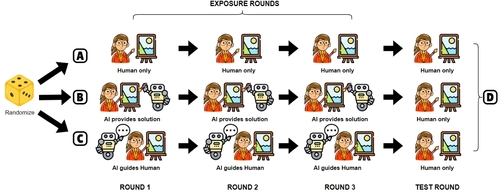
Experimental framework for measuring the impact of AI use on Human creativity. Participants engage in a series of Exposure rounds where they are randomized to either receive – (A) No assistance, (B) LLM solution (standard): This could be analogous to using a chat LLM such as ChatGPT for the task, or (C) LLM guidance (coach-like): In this case, participants receive response from a customized LLM which guides them through the creative process. Finally, in the last round, all participants are asked to do the same creative task without any assistance as a Test. (D) The performance and creative outputs in this unassisted round are the primary measures for evaluating the impact of using LLMs on Human cognition.
2.3 Generative AI and Human Cognition
The continued use of Generative AI is significantly impacting our society, particularly in how
culture is created and propagated [
3,
12]. These technologies are reshaping the production of cultural artifacts and the means through which culture is disseminated and experienced. The influence of Generative AI extends to our cognitive abilities, with effects that may be polarizing [
27]. On the one hand, the pervasive use of AI tools might lead to a massive homogenization of creative output, a trend that could persist even after humans stop using these tools [
2]. This raises concerns about the potential stifling of creativity and the reduction of diversity in thought and expression. On the other hand, Generative AI can unlock unprecedented creative growth and learning, allowing users to expand their cognitive horizons and engage in innovative forms of thought.
Hofman
et al. [
28] introduced a sports metaphor to conceptualize the spectrum of the impact of Generative AI on human cognition. They describe three distinct roles that AI can play: steroids, sneakers, and coach. “Steroids” represent AI as a tool that provides short-term performance gains, but with potential long-term detrimental effects. “Sneakers” symbolize AI tools that augment human skills without long-term adverse consequences. Lastly, the “Coach” role reflects AI as a guide that helps individuals improve their own capabilities, extending beyond immediate assistance to foster long-term cognitive growth. Collins
et al. [
15] proposed AI systems as ‘thought partners,’ designed to meet human expectations and complement our cognitive limitations. They outline several modes of collaborative thought in which humans and AI can engage, drawing insights from computational cognitive science to suggest how these partnerships can enhance human thinking.
Situating work in broader HCI literature. Although the long-term effects of Generative AI use has been studied empirically in domains such as education [
5,
35], web search [
57], etc., there is a lack of empirical evidence on the effect of Generative AI tools on our convergent and divergent thinking abilities. Our approach differs significantly from previous work that focuses solely on measuring and improving the creative output of LLMs themselves [
40], without considering how their use affects human (user) creativity. Unlike previous work, we examine and discuss both aspects of creativity (divergent and convergent thinking) together for a comprehensive understanding of how LLMs shape human creative processes. Prior studies have used AUT and RAT to evaluate the creative abilities of LLMs [
33,
40] or to assess Human+AI creativity under a single exposure [
3]. In contrast, our work approximates real-world interactions by incorporating multiple sequential exposures to LLMs. This allowed us to capture how users adapt their creative processes over time, providing a more realistic assessment of the impacts of LLM-assisted creativity. In addition, we experimentally measure the impact of these repeated exposures on
human creativity (residual effects of using LLMs), an aspect missing from existing research on LLM and creativity.
3 Experiment 1: Divergent Thinking
A critical aspect of creativity is the ability to generate a wide range of high-quality ideas, often called divergent thinking [
25,
51]. LLMs have the capacity to generate a significant quantity of ideas, often exceeding what an individual can produce, without the constraints of time or context. However, the impact of using LLM-generated ideas on an individual’s ability to think divergently and come up with ideas independently remains underexplored. In addition to producing ideas, LLMs can offer structured frameworks that guide users in their creative processes, much like a coach [
4]. To understand these dynamics, our first pre-registered
1 experiment investigates the effects of LLMs that either directly provide ideas or guide participants using a framework, helping them to develop their own ideas.
3.1 Experimental Design
We designed a three-condition, between-subjects experiment to understand how participants’ unassisted divergent thinking is affected by the presence of LLM assistance during prior divergent thinking tasks (see Figure
2). The study was approved by the ethics board of the local university. We employed the Alternate Uses Test (AUT), which is the most widely used divergent thinking task [
25]. Participants in this task were asked to come up with novel and creative uses for common everyday objects, outside of their intended use. They were told “The goal is to come up with creative ideas, which are ideas that strike people as clever, unusual, interesting, uncommon, humorous, innovative, or different. Your ideas don’t have to be practical or realistic; they can be silly or strange, even, so long as they are CREATIVE uses rather than ordinary uses…’’. For instance, an alternate use of pants might be as a makeshift flag.
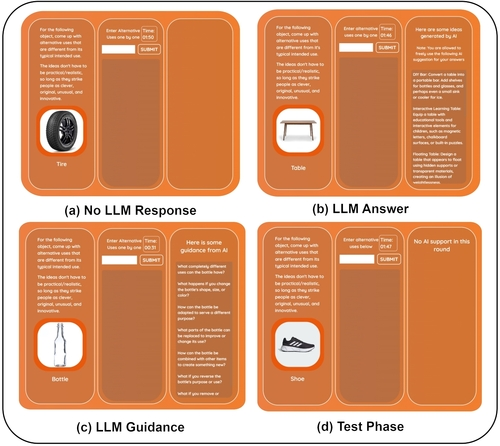
Interface used in the divergent thinking experiment across all 3 exposure round conditions and test rounds.
3.1.1 Experimental conditions and treatment.
Our experimental design involved two main phases: an exposure (paired) phase during which participants attempted the task with an LLM partner, and a test (solo) phase during which participants attempted the task on their own. Participants were given two-minute time frames per object to submit their ideas one by one, and could freely edit or delete any previously submitted ideas. We control for time per task to emulate real-world scenarios where knowledge workers will have the same deadline for a task, irrespective of whether they are using LLM or not. During the exposure phase, participants are introduced to three objects, one after the other. Every participant was randomly assigned to receive one of three types of LLM responses:
The
List of Strategies condition was designed to capture a common real-world use of LLMs: obtaining structured thinking or brainstorming frameworks rather than direct answers. Although this approach may introduce additional cognitive load during the
exposure phase, it can potentially foster deeper, more enduring benefits observed during the
test phase—an effect analogous to the long-term learning advantages reported in educational studies leveraging LLMs [
5,
35]. The assigned type of LLM response appeared 5 seconds after the item was shown to the participant, and appeared character by character, similar to other chat LLM interfaces. Figure
2 shows the schema of the experiment design. Following the exposure phase, participants engaged in a brief distractor task to simulate forgetting, playing a game of Snake for one minute. In this subsequent phase, participants were assigned the Alternate Uses Task for a new object selected at random, this time without LLM support. None of the participants in any condition had LLM support in the
test round. This was done to measure the residual effects of the use of LLMs in previous
exposure rounds.
Participants completed a pre-survey before beginning the experiment and a post-survey after completing the test phase, where we collected self-perceived creativity levels and their attitudes toward AI, along with other subjective measures (such as perceived difficulty of the test round, any strategies they utilized, and if there were any technical issues).
3.1.2 Stimuli.
The items in each round were randomly sampled from five items: tire, pants, shoe, table, bottle. We chose these five particular objects as the originality scoring measure had the highest correlation with human judgements for these five objects [
44]. Figure
3 shows the different responses shown to participants in different conditions.
3.1.3 Dependent Variables.
AUT allows us to measure different dimensions of divergent thinking. As such, using LLMs may impact each of these dimensions differently. These dimensions include:
•
Originality (How original the idea is): We measure the originality of each AUT idea with an existing fine-tuned GPT-3 classifier [
44]. The model was fine-tuned with human judgments of AUT originality (where human raters judged, on a scale of 1 to 5, the originality of an idea given the object) and achieved an
r = 0.81 overall correlation with human judgments. For our experiment, we chose the five items that had the highest accuracy for the model (
r > 0.88).
•
Fluency (How many ideas): We measure fluency by counting the number of ideas the participant generated in a given round.
•
Individual-level diversity of idea set (How different are ideas compared to each other for a given object): We first embed all ideas using SBERT [
49]. Idea diversity is the median pairwise cosine distance between idea embeddings in the idea set. This is a complementary measure to Originality. While Originality is a property of the idea, Diversity is a property of the idea set, so it is possible to have a diverse set of non-creative ideas if each individual idea is not creative (by originality metric) but different from one another [
3].
•
Creative flexibility (How different are ideas in the Test round compared to the Exposure rounds): Creative flexibility allows participants to switch between different concepts and perspectives. This is also sometimes referred to as
p-creativity. In the framework of our experiment, we operationalize flexibility by checking how similar the ideas generated in the Test round are to the ideas generated in the Exposure rounds. We measure this by finding the maximum cosine similarity between the embedding of an idea in the Test set and all the ideas in the Exposure set. We use the maximum rather than a measure of central tendency because if a participant is inspired by an idea, it would likely be a single idea [
50].
•
Group-level diversity of ideas (How different are the ideas generated by participants across the group for a given phase): The goal of this analysis was to simulate how individuals contribute to idea generation as a group, with a focus on understanding the potential homogenization of ideas at the group level. Specifically, we aimed to study whether LLM assistance leads to a convergence of ideas, reducing diversity within a group. To achieve this, we performed 150 Monte Carlo runs, where we sampled 7 ideas per round, simulating group contribution dynamics. We calculated the median pairwise cosine distances between the embeddings of these ideas, using SBERT to encode them. This sampling process reflects the number of participants in each condition. The median pairwise cosine distance across each Monte Carlo run was used to evaluate diversity for each phase and condition. This approach allowed us to assess whether different forms of LLM assistance (e.g., providing direct ideas or acting as a coach) promote homogenization or help maintain diversity of ideas at the group level, even after stopping to use LLMs.
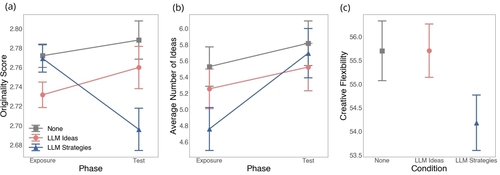
Fig 4 Plots of the Alternate Uses Task ideas for the various divergent thinking dimensions (Segmented by phase and/or LLM response type). The left figure shows idea originality scores, the middle figure indicates idea fluency, and the right figure presents participant creative flexibility.
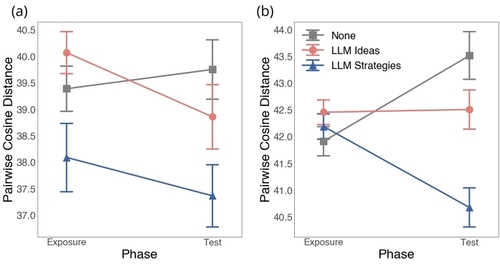
Fig 5 Plots of the average individual- (left) and group-level (right) median diversity, segmented by experiment conditions and phases. Higher values denote more difference between ideas. Error bars represent ± one standard error of mean.
3.1.4 Analysis.
We follow a long tradition of scoring responses to the AUT computationally [
6,
7]. Following our pre-registration, we conducted a Kruskal-Wallis H test to compare the distribution of originality across the three conditions: None, List of Ideas, and List of Strategies, using a significance level of 0.05. In the event of a significant Kruskal-Wallis result, Dunn’s test with Bonferroni correction was applied as a post-hoc test for pairwise comparisons between the conditions.
This same analysis procedure was applied for other dependent variables, including individual-level and group-level diversity, fluency, and creative flexibility. We report the significance of the overall Kruskal-Wallis H test and the results of Dunn’s test for specific pairwise comparisons for each measure.
3.1.5 Participants.
We recruited 460 participants from Prolific. Based on a power analysis using simulated and pilot data, we determined that this sample size will be necessary to achieve 70% power with a moderate effect size and a significance level of 0.05. The overall experiment took around 12 minutes to complete and participants were paid $1.57. Participants were based in the US or UK, and fluent in English. On average, participants felt they were more creative than 48.12% of the population, at the start of the experiment.
3.2 Results
We report on the analysis of 9,457 ideas generated by participants across all conditions and phases.
3.2.1 Originality.
Figure
4 a shows the average originality of ideas across conditions. In the
Exposure phase, the mean originality was similar across conditions, as indicated by the Kruskal-Wallis H test (
H(2) = 3.78,
p = 0.151). Interestingly, participants who received the
List of Ideas performed slightly worse than other conditions, despite being exposed to LLM ideas with a mean originality of 3.25 (± 0.1). This is nearly 0.5 points higher than the average originality of ideas generated by participants in this condition (on a scale of 1 to 5). This discrepancy suggests that participants may struggle to accurately assess the quality of AI-generated ideas, or perhaps, when provided with AI ideas, they may prioritize coming up with their own, potentially lower-quality ideas. These findings highlight the need for designing effective reliance mechanisms that help users fully leverage the benefits of AI-generated ideas, beyond simply improving AI’s output quality.
In the Test phase, the pattern shifts. The Kruskal-Wallis H test reveals significant differences in originality across conditions (H(2) = 9.14, p = 0.010). Post-hoc pairwise comparisons using Dunn’s test with Bonferroni correction indicate that participants exposed to the List of Strategies performed significantly worse than those with no LLM exposure (p = 0.009). Additionally, the originality of participants in the List of Strategies condition decreased from the exposure to the test round, suggesting that they did not successfully internalize the strategies well enough to apply them independently. Neither the comparison between List of Ideas and List of Strategies (p = 0.126), nor the comparison between List of Ideas and No LLM Response (p = 1.000) showed significant differences. This suggests that the List of Ideas condition may fall somewhere in between, without a strong directional impact on originality. Overall, these results suggest that participants tended to perform better, in terms of originality, when they had no prior exposure to LLMs in the test phase.
3.2.2 Fluency.
Figure
4 b shows the average number of ideas generated by participants across different conditions. During the
Exposure phase, the Kruskal-Wallis H test revealed significant differences in fluency across conditions (
H(2) = 8.57,
p = 0.014). Participants who received the
List of Strategies produced significantly fewer ideas compared to those without LLM exposure, as indicated by Dunn’s post-hoc test (
p = 0.011). This may be because reading and applying strategies require more time, potentially reducing the number of ideas generated, even though the originality of these ideas remained comparable to the
No LLM Response condition (as discussed earlier). Interestingly, participants who received the
List of Ideas submitted nearly two fewer ideas than what was shown to them on average per round, being shown seven ideas each round, possibly supporting the hypothesis that individuals may prioritize generating their own ideas over simply adopting AI-provided ones.
In the Test phase, however, the Kruskal-Wallis H test did not indicate any significant differences in fluency across conditions (H(2) = 1.14, p = 0.566), suggesting that prior exposure to LLMs may not significantly impact the quantity of ideas participants can produce independently in subsequent rounds of AUT.
3.2.3 Creative Flexibility.
Figure
4 c shows the average creative flexibility across conditions, which measures how different the ideas produced in the Test round are from those produced in the Exposure rounds (a higher value indicates more dissimilarity). The Kruskal-Wallis H test revealed a significant difference in creative flexibility across conditions (
H(2) = 6.31,
p = 0.043). However, post-hoc pairwise comparisons using Dunn’s test with Bonferroni correction did not reach significance after correcting for multiple comparisons. Directionally, participants in the
List of Strategies condition tended to produce ideas in the Test round that were more similar to those from the Exposure rounds compared to other conditions (
p = 0.052 when compared to
No LLM Response). Applying the same strategies to different objects may have led to more similar final outcomes across rounds.
3.2.4 Individual- and Group-level Diversity of Idea Set.
Figure
5 a shows the trend in the individual-level diversity of ideas produced by participants. In the
Exposure phase, the Kruskal-Wallis H test revealed a significant difference between conditions (
H(2) = 9.95,
p = 0.007). Post-hoc pairwise comparisons indicated that participants who received the
List of Strategies produced significantly more similar ideas within each round compared to those in the
List of Ideas condition (
p = 0.009) and the
No LLM Response condition (
p = 0.041). In contrast, there was no significant difference between the
List of Ideas and
No LLM Response conditions (
p = 1.000). The Kruskal-Wallis test for the
Test phase also showed a significant difference between conditions (
H(2) = 7.71,
p = 0.021). Participants in the
List of Strategies condition continued to generate more similar ideas compared to those in the
No LLM Response condition (
p = 0.017), although no significant difference was found between the
List of Strategies and
List of Ideas conditions (
p = 0.348), or between
No LLM Response and
List of Ideas (
p = 0.747).
Interestingly, while both LLM-assisted conditions showed a decline in idea diversity across rounds, participants in the No LLM Response condition maintained or even slightly improved their diversity. This result is somewhat unexpected, as it might have been assumed that unassisted participants would experience fatigue, leading to less varied ideas over time, whereas those who had support during the exposure rounds would be better equipped to produce diverse ideas.
We simulated group-level diversity by randomly sampling ideas across participants based on their condition, item, and phase. Figure
5 b illustrates the trends in group-level diversity. In the
Exposure rounds, the average median cosine distance between ideas was similar across all conditions (
p > 0.05), which is unexpected. Participants in the
List of Ideas condition, who had access to the same LLM-generated ideas, were expected to produce more similar ideas as a group. However, this may be due to participants not fully adopting the AI suggestions, as indicated by earlier findings. Additionally, the random sampling of 7 ideas from a pool of 20 for each object may have contributed to the lack of overlap.
Interestingly, participants exposed to LLM-generated strategies during the exposure phase continued to generate more similar ideas in the test phase, even without LLM assistance, a phenomenon known as homogenization. This raises concerns that LLMs, which provide ubiquitous frameworks for thinking, could lead to reduced diversity in collective thinking, with people continuing to produce similar ideas even after they stop using the LLM.
3.2.5 Subjective Measures and Perceptions.
Figure
6 summarizes participants’ self-reported measures of creativity, feelings toward AI use, and the difficulty of generating uses for the
Test object. Across all conditions, participants reported a decline in their perceived creativity after the experiment, a consistent drop that is somewhat unexpected. One might assume that receiving a list of AI-generated ideas would either further diminish creativity, as participants might feel they cannot match the AI, or conversely, seeing strategies during exposure rounds could boost their self-assessed creativity by providing structured guidance.
The change in participants’ feelings toward AI remained relatively stable across conditions, with those in the List of Ideas condition reporting more than double the magnitude of change compared to the other groups. Interestingly, participants who received a list of ideas during the exposure rounds also found it easier to generate their own ideas during the test phase. This is surprising, as one might expect that exposure to AI-generated ideas would make it harder for participants to think independently in the test round, and that AI strategies in exposure would make it easier to independently come up with ideas.
4 Experiment 2: Convergent Thinking
The results from our first experiment highlight how LLMs shape our ability to generate ideas independently. However, creativity involves more than idea generation; it requires the capacity to identify and refine the most appropriate solutions within a given conceptual space. Convergent thinking is crucial for advancing from a broad set of ideas to selecting the most viable outcome. Motivated by this, our second pre-registered
2 experiment focuses on convergent thinking, testing not only LLM-generated answers but also the potential of LLMs to guide users toward solutions, simulating a coaching approach.
4.1 Experimental Design
We conducted a second three-condition, between-subjects experiment to understand how participants’ unassisted convergent thinking performance are affected by the presence of LLM assistance during prior convergent thinking tasks (see Figure
7). We employed the Remote Associates Test (RAT), a widely recognized task for measuring convergent thinking. For each RAT problem, participants are presented with three words and asked to generate a fourth word that connects or fits all three words within a one-minute timeframe. For example, given the words
shelf,
log, and
worm, the correct response would be ‘book’ (
bookshelf, log
book,
bookworm). We selected this task due to its widespread use in prior research [
16,
34], and its compatibility with LLMs.
Similarly to the previous experiment, this study included both exposure (paired) and test (solo) phases. Figure
7 gives a high-level overview of the experiment schema. The experiment had participants complete a series of RAT problems alongside AI assistance (exposure phase), before completing unassisted RAT problems (test phase). The experiment was designed to give us insight into how convergent thinking skills are impacted by different levels of AI assistant, as well as by immediate prior use of AI assistance. Because a given RAT problem has a singular correct answer, we were able to define the metric for convergent thinking skills as accuracy on the RAT problems. We additionally collected perceptions and sentiments before and after the experiment to see how these were impact by completing the tasks alongside AI assistance or not.
4.1.1 Conditions and treatment.
During the exposure phase, participants were required to solve three RAT problems consecutively. They were randomly assigned to one of three conditions, each providing different types of LLM assistance:
Similar to Experiment-1, the LLM Guidance condition was inspired by a common real-world method of using LLMs to obtain structured thinking frameworks rather than direct answers. After the exposure phase, participants played a game of Snake for one minute which served as a distractor task. In the test phase, all participants completed two additional RAT rounds (randomly selected) to attempt without any LLM assistance.
The
No LLM Response (Figure
8 a) condition serves as a baseline, reflecting the state of convergent thinking without AI assistance. The
LLM Answer (Figure
8 b) condition represents the scenario in which AI provides ready-made solutions. The
LLM Guidance (Figure
8 c) condition was designed to assist participants in navigating the conceptual space of the problem without directly revealing the answer. This approach aims to enable participants to solve the problem independently while still offering useful guidance in the moment. Research has shown that priming with related words and manually writing responses can enhance performance on RATs—strategies a coach might use for guidance [
13,
43].
In all conditions, the assigned type of LLM response appeared 5 seconds after the question was shown to the participant, with the text being displayed character by character, mimicking typical chat-based LLM interfaces. In the LLM Answer and LLM Guidance conditions, the interface informed participants they could freely use the AI suggestions in their answers. Although the RAT has participants employ creative thinking, there is always one definitive answer. As such, we wanted to avoid the case in which a participant was prompted with the correct answer by AI, acknowledged that it was the correct answer, but then felt as though they should attempt to find a different solution to be “more creative”.
During the exposure rounds, participants were made to wait the full 1 minute before advancing to the next task, while in the test rounds, participants could advance once they submitted an answer. This was to discourage participants from speeding through the experiment without giving thought to their answers. Like Experiment-1, we control for time per question to map onto real-world scenarios of LLM use in work environments. Participants were never shown the correct answer to the RATs they completed (except as part of LLM responses, if applicable), nor were they informed if their answers were correct.
4.1.2 Stimulus.
For the Remote Associates Test (RAT), we employed a widely-used dataset from Bowden and Jung-Beeman [
11]. The subset we selected contained 45 questions equally distributed across three difficulty levels: easy, medium, and hard. For our study, we randomly selected questions from the easy and medium difficulty levels for each round, as pilot testing indicated that these were appropriate for our participant pool (crowdworkers). Figure provides examples of the LLM responses presented to participants in the different experimental conditions.
4.1.3 Verbal Fluency and Surveys.
At the start of the experiment, participants completed a verbal fluency task, where they were asked to list as many English words as possible within one minute, starting with a given letter (e.g., ‘F’). We implemented this measure to account for participants with low English language proficiency, which can significantly confound performance on the RAT [
26,
60]. Following this, participants received instructions for the RAT, along with additional information specific to each experimental condition. After the instructions, participants completed a survey assessing:
•
Self-reported creativity, measured as a sliding value from 1-100, with the prompt: I am more creative than X% of humans.
•
Attitudes toward AI use in daily life, measured as a multiple choice question with options; “More concerned than excited”, “Equally excited and concerned”, and “More excited than concerned”.
After finishing the final test round, participants were surveyed again on these same questions, as well as:
•
Perceived test round difficulty, measured with the prompt “How difficult was it to come up the associated word for the last two (test) tasks?” with options; “Very easy”, “Somewhat easy”, “Somewhat difficult”, and “Very difficult”.
•
Perceived helpfulness of exposure rounds measured with the prompt “How helpful was the exposure phase (first three questions)?” with options; “Not at all helpful”, “A little helpful”, and “Very helpful”
The post-experiment survey also contained a basic attention check.
4.1.4 Analysis.
Following our pre-registration, we conducted an Analysis of Covariance (ANCOVA) to compare the average accuracy between the three conditions in test rounds, controlling for the number of words generated in the verbal fluency task as a covariate. We used Tukey’s Honestly Significant Difference (HSD) test as a post-hoc test for pairwise comparisons between conditions after a significant ANCOVA result.
4.1.5 Participants.
We recruited 640 participants from Prolific (of whom 99% passed the attention check). The sample size was determined through a power analysis using simulated data from pilot studies, ensuring 80% power for the main pre-registered test. Participants were based in the US or UK, and were fluent in English. The task took approximately 10 minutes to complete and the participants were paid $1.30. On average, the participants felt they were more creative than 46.4% of the population, and they were able to generate 13.3 words in the verbal fluency task.
4.2 Results
4.2.1 Accuracy in the Test Rounds.
As shown in Figure
9, participants in the
LLM Answer condition did better in the Exposure rounds in comparison to the other conditions. However, this trend changed in the Test rounds. Following our pre-registered analysis plan, the ANCOVA revealed a significant effect of verbal fluency on performance (
F(1, 1256) = 16.715,
p < 0.001) as well as a significant main effect of condition (
F(2, 1256) = 5.134,
p = 0.006). Post-hoc comparisons using Tukey’s HSD test indicated that participants in the
LLM Guidance condition performed significantly worse than those who did not receive any LLM responses in exposure rounds (
p = 0.005), with a mean difference of − 10.6 [95% CI: − 18.6, −2.7]. While the
LLM Answer condition did not differ significantly from the
No LLM Assistance condition (
p = 0.682), there was a trend suggesting that the
LLM Guidance condition performed worse than the
LLM Answer condition (
p = 0.064).
This suggests that, although the difference between the LLM Answer and LLM Guidance conditions did not reach statistical significance levels, the LLM Answer condition may lie somewhere in between the other two conditions. However, this observation should be interpreted cautiously, given the lack of statistical significance in this comparison.
The positive performance of participants in the LLM Answer condition during exposure rounds underscores the effectiveness of LLMs in providing accurate solutions to the task. This suggests that LLMs are indeed proficient at generating correct answers and that participants are capable of recognizing when to leverage LLM advice effectively. Exposure to LLM assistance—whether in the form of direct answers or strategic guidance—did not translate into enhanced unaided performance and may have even been counterproductive. This phenomenon can be understood through the lens of convergent thinking, which often relies on achieving an ’aha’ moment or insight. LLM Guidance might have disrupted this process by providing too much additional information to take in, thereby hindering the natural cognitive processes necessary for independent problem-solving. Similarly, LLM Answer could have impeded participants’ engagement in their own creative thinking, as they might have become overly reliant on external solutions rather than developing their own problem-solving strategies.
4.2.2 Subjective Measures and Perceptions.
Figure
10 shows participants’ change in self-reported levels of creativity, change in feelings towards AI use perceived difficulty of test rounds, and perceived helpfulness of exposure rounds. In
plot (a), we see that across all experimental conditions, participants exhibited a reduction in self-reported creativity ratings from pre-experiment to post-experiment surveys. Both
LLM Answer and
LLM Guidance conditions saw a greater average reduction in creativity ratings, with
LLM Guidance showing an average reduction more than twice as substantial as that observed in the
No LLM Assistance condition. This suggests that reliance on LLMs, particularly in the
LLM Guidance condition, may have undermined participants’ confidence in their own creative abilities. The more substantial reduction in creativity ratings for
LLM Guidance could indicate that receiving a wide range of possible word connections, rather than necessarily coming up with their own, diminished participants’ sense of ownership over their creative process. Futrthermore, the less significant decrease observed in the
LLM Answer condition could be from participants recognizing they were receiving direct answers which were completely detached from their own creative abilities.
Plot (b) shows that the change in attitudes toward AI use in daily life stayed roughly constant between pre-experiment to post-experiment surveys. with
LLM Answer seeing slight attitude increase. Feelings towards AI use was measured using a 3-point Likert scale (with values being “More concerned than excited”, “Equally excited and concerned” “More excited than concerned”). This slight increase in positive attitudes toward AI in the
LLM Answer condition could be attributed to participants recognizing the effectiveness of LLMs in completing tasks accurately, reinforcing their confidence in AI’s capabilities. The reliable performance of the LLM may have led to a more favorable view of its potential for everyday use. In
plot (c), perceived difficulty of the test rounds was highest for the
LLM Guidance condition, and slightly lower in the
No LLM Assistance and
LLM Answer conditions. That is to say, test rounds felt more difficult when the participant had completed previous tasks with guiding AI assistance, rather than just a straight answer, or no assistance at all. On average, perceived difficulty was slightly above 2.5 on a 4-point Likert scale (ranging from “very easy” to “very difficult”). meaning that participants found test rounds a little on the difficult side. The higher perceived difficulty in the
LLM Guidance condition may be due to participants relying on the given word associations during the exposure rounds, which might have made it harder for them to independently generate associations in the test rounds where no assistance was given. Finally,
plot (d) measured the percentage of participants who found the exposure helpful for their completion of the test rounds. Note that this was not explicitly measuring whether participants found the LLM assistance helpful, but rather whether completing the exposure rounds aided them in performing the test rounds. Participants who received no LLM assistance during the exposure rounds were the most likely to find these rounds helpful. In comparison, the proportion of participants who found the exposure rounds helpful was roughly 5% lower in the
LLM Answer condition and 7% lower in the
LLM Guidance condition. This result may suggest that participants without LLM assistance had to rely more on their own problem-solving strategies during the exposure rounds, which could have enhanced their perceived usefulness of these rounds in preparing for the test phase. In contrast, those receiving LLM assistance might have become more dependent on the AI, leading to a lower perception of the exposure rounds’ value for their independent performance during the test rounds.
5 Discussion
5.1 Key Findings
5.1.1 LLMs Boost Performance During Exposure, but Unassisted Participants Excel in Test.
Across both experiments, we observed that LLM assistance was helpful during the exposure phase, aligning with previous research that highlights LLMs’ ability to enhance creative task performance when users have access to AI-generated ideas or strategies [
2,
14]. However, in the test phase, participants who had no prior exposure to LLMs consistently performed better (this was not statistically significant in all cases). In the divergent thinking task, participants who worked without LLM assistance generated more original ideas on average, and in the convergent thinking task, those without LLM exposure were better able to identify the correct connecting word compared to those who had LLM exposure. These findings suggest that while
LLMs may provide short-term boosts in creativity during assisted tasks, they might inadvertently hinder independent creative performance when users are asked to perform without assistance. This raises important questions about the long-term impact of repeated LLM use on human creativity and cognition.From a design perspective, it is critical to consider not just human-AI performance during exposure phases but also human performance in unassisted tasks after using AI. Systems should be designed with long-term human flourishing in mind, ensuring that the benefits of AI assistance do not come at the cost of diminished independent creative abilities. Ensuring that users can effectively transition from AI-supported creativity to autonomous creative work will help mitigate potential long-term harms associated with over-reliance on LLMs, as highlighted by concerns in the literature about cognitive decline with repeated AI use [
27].
5.1.2 Differential Impact of LLMs on Divergent and Convergent Thinking.
Our experiments reveal that the effects of LLMs vary significantly depending on the aspect of creativity being measured. In divergent thinking tasks, where participants were asked to generate a wide range of ideas, we observed more skepticism toward LLM assistance. Participants seemed less inclined to adopt AI-generated suggestions, which may be due to the nature of divergent thinking itself—encouraging exploration and unconventional approaches [
4,
25,
51,
53]. In contrast, for the convergent thinking task, where participants were tasked with narrowing down the ideas to a single solution, LLM assistance during the exposure phase appeared more beneficial. This is consistent with the idea that convergent thinking is more structured and goal-oriented, making it easier for participants to recognize when LLMs are effectively guiding them toward the correct solution [
17,
42,
56].
LLMs, however, may also hinder the creative process. In divergent thinking, the introduction of AI-generated ideas may distract participants, consume valuable cognitive resources, or prevent full engagement with the task. This aligns with theories of creativity such as Boden’s concept of
conceptual spaces, which emphasize the importance of users exploring and navigating creative possibilities independently [
9]. Over-reliance on LLMs during divergent thinking may disrupt this exploration, leading to less original ideas, as seen in the originality results (Figure
4). Similarly, in convergent thinking tasks, LLMs might steer participants toward specific solutions too quickly, reducing the need for deep engagement with the problem space [
25].
These findings underscore the importance of carefully calibrating trust and reliance in human-LLM systems. Designers should incorporate measures that help users recognize when to trust and rely on LLMs, and when to prioritize their own cognitive processes. This approach can help balance the benefits of AI support with the risks of undermining the human creative process, ensuring that LLMs enhance rather than detract from creativity in the long term.
5.1.3 Persistent Homogenization of Ideas and the Challenges of Designing LLM Coaches.
Existing research has shown that LLM usage can lead to the homogenization of ideas within groups, where participants tend to converge on similar outcomes when using AI-generated suggestions [
2,
19,
45]. Our findings extend this concern, showing that even when people stop using LLMs that provide strategic frameworks for thinking, the homogenization effect can persist. In our divergent thinking experiment, participants who received LLM-generated strategies exhibited reduced diversity in their idea sets both during and after LLM use, suggesting that such frameworks may have a lasting impact on creative processes, potentially stifling the generation of more varied or unconventional ideas.
Interestingly, we did not find the same effect for participants who received direct ideas from a standard LLM. The
List of Ideas condition did not lead to the same lasting homogenization once the LLM was no longer present. This indicates that while LLM-generated strategies can have long-term effects on creative diversity, providing ideas without a guiding framework may allow for more cognitive flexibility once participants stop using AI. Further, participants with no LLM interactions in the study collectively generated the most diverse idea sets (Figure
5). In our convergent thinking experiment, participants who received LLM guidance during exposure performed worse in the test round compared to those who received direct answers. This highlights the complexity of designing LLMs as coaches or guides. While direct answers may not always seem ideal, in some cases, they can be more effective than offering frameworks or strategies. Designers of Human-AI systems must take these findings into account, ensuring that LLM interactions are structured to avoid unintentional long-term effects on cognitive diversity. Controlled experiments, such as those conducted here, can be useful methods in refining and optimizing the design of coach-like LLM systems [
35,
57].
5.2 Broader Implications for Fields Involving Human-AI Co-Creativity
When designing AI tools for co-creativity, it is crucial to consider their long-term impact on human cognitive abilities. Hofman
et al. [
28] introduced a useful metaphor—steroids, sneakers, and coach—to describe the spectrum of AI’s role in human-AI collaboration.
Our findings suggest that co-creative systems must be carefully designed to be coach-like to prevent unintended consequences, such as stifling human creativity, even after AI assistance is removed.These insights have broad implications for various fields, from scientific discovery to the arts and humanities. In the context of AI for science, for instance, there is ongoing excitement about building increasingly sophisticated models to accelerate the process of hypothesis generation and experimental execution [
10,
39,
55]. However, the design of these models often overlooks their potential impact on scientists’ creative abilities. Although some initial explorations have been conducted, the field lacks rigorous empirical evaluation of how AI systems affect human creativity in scientific discovery. The arts and humanities may face similar challenges [
47]. For example, writers using the same LLM could produce homogenized content, even when AI is no longer part of their workflow. This underscores the need for AI systems that not only assist in the creative process but also promote long-term cognitive diversity, ensuring that human creativity thrives in collaboration with AI rather than becoming constrained by it.
Our work in a controlled, simple setting suggests that the performance of AI models alone is not enough to determine their value. The design of human-AI interactions—whether AI provides direct answers or encourages users to think critically—and the timing of performance evaluation (during AI use versus after) both significantly alter the narrative. These considerations are critical in ensuring that AI models enhance, rather than diminish, human creative potential. Beyond simply building superhuman AI, we must focus on how these tools influence human creativity, culture, and cognitive growth, aiming for AI systems that enrich and elevate human thought [
12,
27].
5.3 Limitations & Future Work
While our study provides valuable insights into the impact of LLMs on human creativity, there are several limitations that warrant further investigation.
Firstly, measuring creativity itself presents challenges. Though we employed both divergent and convergent thinking tasks (AUT and RAT) to capture a broad spectrum of creative processes, these tasks were limited to verbal responses and conducted over short time periods. Creativity, however, is a much more complex and nuanced phenomenon. Future work should expand the battery of tasks to include more natural, real-world creative activities, such as writing advertisements, designing magic tricks, or solving complex problems. Additionally, creativity tasks that are non-verbal or visual, like those supported by diffusion models, could be explored. Experiments using visual creativity tasks, such as the Test of Creative Thinking Drawing Production (TCT-DP) or the Evaluation of Potential Creativity (EoPC) [
41], would provide deeper insights into how LLMs impact creativity in non-text domains.
Our study also focused exclusively on the active, conscious aspects of creativity, largely due to the controlled lab environment. Yet, creativity often involves unconscious processes that are harder to capture in such settings. Another limitation lies in the short exposure period in our lab-based study. In real-world settings, exposure to LLMs is often prolonged, integrated into daily workflows, and thus, likely produces more significant and lasting effects on creativity. In contrast, our study’s shorter exposure periods may have resulted in smaller effect sizes, limiting our ability to fully understand the long-term implications of LLM use. Future research should explore prolonged interactions with LLMs to better reflect real-world scenarios and study potential cumulative impacts on creativity. We acknowledge that limiting the AUT objects in Experiment-1 to five is a limitation. We selected them due to the strong correlation between our automated scoring method and human judgments for these objects, which enabled us to evaluate 10,000 ideas at scale without prohibitive human annotation, in line with other large-scale creativity studies that have operated under similar constraints [
3].
Additionally, the design of our LLM-based guidance presents limitations. In the convergent thinking task, the guidance provided was naturally more verbose than direct answers, which may have inadvertently influenced the results. The list-of-strategies and guidance conditions introduced more cognitive load and hence the comparisons with the default conditions during exposure may have been unfair. Future studies should control for verbosity and ensure that the nature of guidance is standardized to more accurately assess the impact of LLM “coaching” versus direct assistance. However, the additional cognitive load during exposure may be beneficial for human cognition long-term as has been shown in education-related experiments. Another approach could be to measure the human performance in the final 30 seconds of the AUT task as the participants may have completed reading/processing LLM output by this time. Future work can also explore the trends in performance split by the different rounds of the experiment. Moreover, participants in the coach conditions may have performed worse during the test due to fatigue build-up in the exposure rounds. Or it could be due to the increased dependency on LLM responses. Future work should investigate the exact mechanisms behind these effects. Finally, although this study represents an early attempt to experimentally measure the impact of LLMs on human creativity, the static nature of our LLM interaction may not fully reflect real-world applications. In practical use cases, AI tools often engage in dynamic, interactive exchanges where users can refine inputs, seek clarifications, or adjust outputs. Future research should investigate how conversational and adaptive LLMs influence creativity over time, as these systems more closely resemble how people use AI in real-world creative processes.
6 Conclusion
Through this work, we sought to understand the impact of LLMs on human creativity. Our work moves beyond a single-use scenario or model-only evaluations. We conducted two parallel experiments on divergent and convergent thinking, two key components of creative thinking. By exploring repeated exposure, we attempt to approximate real-world interactions with LLMs and investigate the lasting impacts on human creative processes. Taken together, these experiments shed light on the complex relationship between human creativity and LLM assistance, suggesting that while AI can augment creativity, the mode of assistance matters greatly and can shape long-term creative abilities. In closing, we hope this work offers a template to experimentally evaluate the impact of generative AI on human cognition and creativity.
READ ARTICLE INCLUDING CHARTS AND REFEENCES


