

THE INDOCTRINATED BRAIN: HOW TO SUCCESSFULLY FEND OFF THE GLOBAL ATTACK ON YOUR MENTAL FREEDOM”
book written by Michael Nehls, MD, PhD, 2023
Ronald Peters, MD – Commentary
“Use it or lose it.”
The aging process leads to loss of muscle (sarcopenia) and memory (hippocampal decline). Both are natural outcomes of a society where people are inclined to eat high fat, low fiber food, too busy to exercise, sacrifice joy and creativity for a salary and sustain high levels of stress. Aerobic fitness and weight training are essential in the last third of life and no one is too old to start. Doing what brings joy and creativity restores memory, focus and concentration
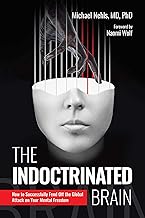 Michael Nehls is a physician and molecular geneticist specializing in immunology who argues that humanity is under a deliberate, multi-pronged assault on cognitive independence. Drawing on neuroscience, Nehls posits that declining mental health worldwide (e.g., rising depression, falling IQs especially among youth, and earlier-onset Alzheimer’s) stems not from coincidence but from orchestrated disruptions to the brain’s hippocampus, the seat of autobiographical memory, individuality, and critical thinking. He frames this as a “global war on the human brain,” enabled by technocratic elites using fear-based narratives (e.g., around viruses, climate change, and borders) to reprogram society toward conformity and control, echoing dystopian visions like Aldous Huxley’s Brave New World. The book blends dense scientific analysis with circumstantial evidence from the COVID-19 era, including lockdowns and mRNA vaccines, while offering practical countermeasures to restore mental resilience.
Nehls structures his thesis around neurobiology and maintains that the hippocampus is the new “battleground” inside the brain. The hippocampus is part of the limbic system which is the control center for basic emotions, such as anger, fear, sadness, and pleasure. The limbic anatomy also generates internal sensations of hunger, libido, dominance and caring for offspring. These neurological signals are combined with life experiences to create memories which are stored in the hippocampus.
The hippocampus in the child is growing rapidly with high levels of new neurons, a process called neurogenesis. Neurogenesis peaks around the age of 10 to 12.
| Aspect | Childhood (≈3–12 years) | Elderly (≈65+ years) |
| Volume | Rapid growth; peaks ~age 10–12 | ~1–2% annual atrophy after age 60 |
| Gray Matter Density | High; ongoing myelination & synaptogenesis | Reduced; neuronal loss, fewer synapses |
| Neurogenesis | Robust (new neurons born in dentate gyrus) | Markedly reduced (~90% decline by age 70) |
Key study: Gogtay et al. (2006) – longitudinal MRI showed hippocampal volume increases until early adolescence, then stabilizes until ~50s, followed by linear decline.
The childhood hippocampus is a high-octane memory factory — growing, highly plastic, and neurogenic. The elderly hippocampus is a fading archive — structurally smaller, less efficient at encoding new traces, and reliant on compensatory brain networks. This shift explains why kids absorb new information like sponges, while older adults excel at crystallized knowledge but struggle with new learning.
The hippocampus plays a key role in forming and storing episodic memories, and its activity is indeed heightened during childhood as the brain undergoes rapid development and learning. During early childhood (e.g., ages 4-8), the hippocampus shows strong differential activation during memory encoding tasks—particularly in anterior and posterior subregions—for items that are later remembered with accurate contextual details versus those that are not. This activation pattern supports improving episodic memory performance, with younger children (4-6 years) exhibiting a stronger link between hippocampal engagement and better memory outcomes, while older children (7-8 years) show increased functional connectivity between the hippocampus and cortical regions like the inferior frontal gyrus and orbital frontal gyrus. Overall, childhood involves maturation of hippocampal subregions, with some volumes (e.g., CA3-dentate gyrus and entorhinal cortex) beginning to show subtle declines starting in mid-childhood but still supporting high plasticity and learning.
In contrast, hippocampal function in elderly individuals (typically from age 60 onward) is characterized by structural and functional decline, leading to reduced efficiency in memory processes. Aging is associated with decreased hippocampal volume, often accelerating after midlife, with subfields like CA1-2 showing linear reductions across the lifespan and others (e.g., CA3-dentate gyrus) exhibiting quadratic patterns that plateau or worsen in later years. This atrophy correlates with cognitive impairments, including poorer episodic memory (e.g., delayed recall), working memory, processing speed, and executive function, even in healthy older adults without neurodegenerative diseases. Unlike the robust, performance-linked activation seen in children, elderly hippocampal activity may become less differentiated or efficient, contributing to age-related memory decline and broader fluid cognition deficits. Factors like individual variability in medial temporal lobe substructures can explain differences in associative memory among older adults, but overall, the shift from childhood’s active maturation to elderly atrophy highlights the hippocampus’s vulnerability to aging.