

From Dysregulation to Coherence: Exploring the HeartMath® Approach to Emotional and Physiological Regulation
Jorina Elbers, MD, MS1,2 and Rollin McCraty, PhD1
Global Advances in Integrative Medicine and Health Volume 14: 1-9
Abstract
Mounting evidence suggests that the long-term effects of trauma and adversity are rooted not only in psychological distress, but in persistent dysregulation of the body’s stress response and its associated neuroendocrine systems. This physiological dysregulation has emerged as a critical contributor to health outcomes, yet remains under-addressed in conventional clinical care. Emotional states are integrated with core physiological functions through dynamic, bidirectional autonomic signaling between the heart, lungs, brainstem, limbic system, and higher cortical areas. This interconnected network enables conscious regulation of breathing, heart rhythms and emotions to influence autonomic and higher cortical functions. Research has demonstrated that heart rhythm patterns become more ordered during HeartMath’s® self-regulation techniques. This stable, high-oscillatory pattern, termed “coherence”, can be observed using heart rate variability biofeedback and induced through slow, deep breathing or experiencing regenerative emotions such as gratitude. Coherence is a state of physiological and emotional regulation that reflects increased vagal activity and synchronization across organ systems, promoting more efficient function. In addition to reductions in perceived stress, research has demonstrated improvements in energy, anxiety, mood, sleep, and cognitive performance with daily coherence practice over weeks. Gradually, coherent heart rhythm patterns can become a more familiar set-point for the body through repeated afferent input to the brain, supporting the emergence of a healthier, more regulated physiological baseline. This narrative review explores HeartMath as an emerging non-pharmacological intervention with therapeutic potential for emotional and physiological dysregulation, highlighting evidence and mechanisms by which coherence shifts the body toward a healthier, more resilient state.
Introduction
Decades of research have demonstrated that chronic stress application of heart rate variability (HRV) coherence bio-feedback presents a promising avenue for mitigating the and adversity contribute to enduring physical and mental health challenges by disrupting neuroendocrine, autonomic, and other core regulatory systems. This narrative review explores the therapeutic potential of HeartMath, a somatic and emotion-focused intervention, in addressing the emo-tional and physiological dysregulation that often follows adversity, trauma or chronic stress. The therapeutic application of heart rate variability (HRV) coherence bio-feedback presents a promising avenue for mitigating the consequences of dysregulation, demonstrating efficacy in addressing stress, anxiety, depression, and chronic disease. HeartMath combines an innovative set of heart-focused self-regulation techniques with HRV biofeedback, enabling in-dividuals to shift into a state of coherence—a physiological pattern marked by high-amplitude, sine wave–like HRV rhythms. With regular practice, this coherent state helps to establish a new homeostatic baseline, promoting greater parasympathetic activity, emotional stability, and physio-logical resilience.
As a non-pharmacological, self-directed intervention, HeartMath provides a low-risk, accessible tool with broad clinical implications for enhancing emotional and physical health across diverse populations.
Adversity, Dysregulation and Disease
A variety of studies looking at both childhood adversity and adult trauma have demonstrated a link between chronic stress and adverse health outcomes. The Adverse Childhood Ex-periences (ACE) Study was a groundbreaking study that demonstrated a dose-dependent relationship between adverse childhood experiences and various negative mental and physical health outcomes later in life.1 This study, whose findings have since been replicated by many others, revealed that the more adverse experiences an individual has during childhood, the higher their risk of negative health outcomes in adulthood, including heart disease, cancer, and chronic lung disease, as well as mental health conditions, such as de-pression, anxiety, and suicide attempts.2 In a systematic re-view of pediatric health outcomes, childhood adversity was associated with delays in cognitive development, asthma, somatic complaints, sleep disruption, obesity and recurrent infections.3 In a nationally representative sample of over nine thousand older adults in the United States, those with lifetime PTSD had higher rates of hypertension, angina, heart disease, gastritis, and arthritis.4 This wide range of health outcomes across the lifespan reflects the multiple systems impacted by a chronically activated stress response.
Decades of research have continued to underscore how excessive or prolonged activation of the body’s stress re-sponse disrupts normal development, and leads to dysregu-lation of neuroendocrine and other physiological systems in both adults and children.5–7 The term “allostatic load” has been used to describe the cumulative physiological “wear and tear” that results from repeated or chronic activation of the stress response leading to multisystem dysregulation over time,5 while the term “toxic stress” is a newly defined term that characterizes the process of physiological dysregulation in response to childhood adversity.6 Dysregulation implies imbalance in the normal control mechanisms that maintain stability and optimal functioning. For instance, dysregulation of the nervous system, a central player in the stress response, has been characterized in children with ACEs demonstrating symptomatic difficulties in executive function, emotional regulation, autonomic function, somatic function, digestion and sleep.7 Dysregulation can also lead to the establishment of a new homeostatic set-point in the body, and be a pre-cursor to a wide range of mental and physical health con-ditions. Dysregulation within the hypothalamic-pituitary-adrenal axis has been implicated in neuropsychiatric condi-tions like depression and schizophrenia,8 while autonomic dysregulation can be found in many complex multisystem conditions such as Chronic Fatigue Syndrome, fibromyalgia and Postural Orthostatic Tachycardia Syndrome.9,10 Stress-induced immune dysregulation has been implicated in type 2 diabetes, asthma, cardiovascular disease and some can-cers.11 While such conditions are also influenced by genetic, environmental and lifestyle factors, it is likely that stress-associated physiological dysregulation contributes to many common health problems. Further research is necessary to better characterize the dysregulated physiological patterns that lead to chronic disease.
Heart Rate Variability as a Stress Biomarker and Therapeutic Target
Stress biomarkers are measurable indicators that can provide insights into the physiological underpinnings of chronic stress and adversity. Heart rate variability (HRV), the variation in time between successive heart beats, has emerged as a leading stress biomarker that reflects autonomic activity and the ability to flexibly modulate between its 2 branches, the sympathetic and parasympathetic nervous systems.12 The autonomic nervous system is responsible for regulating in-voluntary bodily functions. For instance, the sympathetic system increases heart rate, while the parasympathetic system slows it down. An optimal amount of HRV reflects greater parasympathetic regulation and supports a flexible, adaptive autonomic response that allows the body to efficiently shift between arousal and relaxation as needed. This increased parasympathetic, or vagal, activity underlies the body’s ca-pacity for rest, recovery, and regulation, supporting functions such as digestion, immune balance, and emotional stability. Individuals with higher HRV demonstrate more effective emotional regulation and lower physiological reactivity to stress compared to those with lower HRV.13 Two recent meta-analyses assessing HRV parameters in individuals with post-traumatic stress disorder (PTSD) demonstrated clear alter-ations in HRV indicating impaired vagal activity and sympatho-vagal imbalance.14,15 These findings support the clinical features observed in PTSD, characterized by a per-sistent state of heightened arousal and reduced ability to return to a baseline state of relaxation. Further to its role as a marker of autonomic function and resilience, the amount of HRV has been associated with the risk of mental and physical health conditions. Results of a meta-analysis showed that patients with major depressive disorder, generalized anxiety disorder and panic disorder exhibited significantly lower HRV compared with controls.16 In the Framingham Heart Study, HRV was a powerful prognostic biomarker for all-cause mortality, independent of other risk factors.17 Finally, in a retrospective cohort study of COVID-19 patients, higher HRV predicted greater chances of survival in older patients, while low HRV predicted admission to the intensive care unit within 1-week of hospitalization.18 The establishment of HRV as a reflection of autonomic flexibility, and a modifiable predictor of disease and recovery, has rendered it a desirable target for therapeutic interventions.
Through its effects on autonomic function and emotional regulation, HRV biofeedback has become a promising tool in the treatment of both mental health conditions and chronic disease. Heart rate variability biofeedback uses a heart rate sensor and software interface that provides real-time HRV, training individuals to consciously influence their heart rhythm patterns and increase HRV through slow, steady breathing or other self-regulation techniques.
According to several meta-analyses, HRV biofeedback has demonstrated effectiveness in the management of stress and anxiety,19 depression,20 as well as post-traumatic stress dis-order.21 In a systematic review of HRV biofeedback in the management of adults with chronic disease, improvements were noted across multiple physical and mental health conditions including hypertension, asthma, cardiovascular prognosis, sleep, chronic pain, anxiety and cognitive per-formance.22 Notably, improvements in these clinical out-comes were often accompanied by increases in HRV, highlighting HRV as a modifiable biomarker, and supporting the role of physiological regulation as a key mechanism in improving health and reducing disease risk.
While much of the previous research has suggested that the benefits of HRV biofeedback relate to an increase in para-sympathetic vagal activity associated with increasing the amount of HRV, recent findings suggest that the stability of HRVoscillatory pattern is also important. A research group at the University of Southern California recently conducted a randomized controlled trial to examine the effect of different heart rate oscillatory patterns on the brain and brain-derived proteins.23–25 This study randomly assigned younger and older adults to daily HRV biofeedback to elicit either a pattern of coherent, high-amplitude heart rate oscillations using slow-paced breathing, or low-amplitude heart rate oscillations through self-selected relaxation practices aimed at main-taining a low and steady heart rate over time. After 4-5-weeks, participants who targeted the high-coherence oscillatory HRV pattern showed an increase in brain volume in a region of the hippocampus,23 enhanced neuroimaging signals associated with cognition and arousal,24 and desirable changes in plasma Alzheimer’s disease-related proteins.25 While these findings are novel and warrant replication in further studies, they point to 2 potential observations: (1) The effects of generating a high-amplitude, coherent heart rate oscillatory pattern go beyond increasing autonomic flexibility, and also have a regulatory influence that is registered at the level of the brain, and (2) Slow-paced breathing at the natural coherence fre-quency to achieve greater stability and a wider range in HRV creates more desirable neurophysiological effects than maintaining a narrow range of heart rate, as occurs with mindfulness meditation or relaxation on its own. The latter point was further confirmed by a group of researchers at Stanford University who found that 5-minutes of controlled breathwork, especially cyclical sighing, produced greater improvements in mood and physiological arousal compared to 5-minutes of mindfulness meditation.26 Although more research is needed, these findings suggest that practices that change afferent signaling—like slow, rhythmic breathing and coherent HRV patterns—can positively affect brain function and other neuro-chemical pathways.
HeartMath’s Coherence Model and Outcomes
The heart and brain communicate through a dynamic bidi-rectional system involving neural (ie. vagal and spinal pathways), hormonal (ie. adrenaline and oxytocin), me-chanical (ie. baroreceptor feedback), and electromagnetic signals that are integrated within the limbic system and central autonomic network to regulate physiological and emotional states.27,28 Over the last 3 decades, research by the HeartMath Institute has helped to describe the influence of afferent signals from the heart on brain activity, emotional experience, and overall performance, and has created practical, scientifically-validated tools that combine HRV biofeedback with heart-focused techniques for self-regulation.28–30 Dis-tinct from traditional clinical-grade and other commercially-available HRV biofeedback systems, which focus on training with paced breathing or simply calculate HRV metrics, the HeartMath system provides real-time interactive feedback that trains users in both physiological and emotional self-regulation through the generation of a coherent heart rhythm pattern.
Self-regulation refers to the ability to manage and control one’s thoughts, emotions, behaviors, and physiological re-sponses to adapt to changing social and environmental de-mands. In recent years, emotional self-regulation has become an important target for therapeutic interventions including mindfulness-based stress reduction, meditation and Heart-Math. The intentional activation of positive emotions such as compassion, kindness, and gratitude have been found to have a beneficial impact on the body’s physiology. These emotions trigger the release of oxytocin and serotonin, which promote feelings of well-being and social connection. Emotion-focused techniques that help individuals shift towards a state of loving kindness or gratitude have been associated with improvements in mood, anxiety, physiological indica-tors (heart rate, blood pressure, cortisol levels, inflammatory markers), stress recovery, and HRV.31–33 The subjective experience of positive or regenerative emotions not only counteracts the physiological effects of stress, but also fa-cilitates and sustains a stable, high-amplitude oscillatory HRV pattern—known as heart rhythm coherence—that reflects a state of synchronized autonomic regulation and physiological efficiency.29
Coherence is defined as a smooth, sine-wavelike heart rate variability (HRV) pattern with high amplitude, reflecting healthy physiological variability and autonomic balance. The coherence model, proposed by the HeartMath Institute, de-scribes this HRV pattern as an inducible afferent signal transmitted throughout the body, creating a state of energetic efficiency characterized by stability, synchrony among os-cillatory systems, and adaptability to changing demands.29 Because HRV reflects the dynamic interplay between the sympathetic and parasympathetic branches of the autonomic nervous system, coherence indicates a regulated and efficient autonomic state. Importantly, coherence is a psychophysio-logical state that can be self-generated through slow, paced breathing (approximately 6 breaths per minute) and stabilized by regenerative emotions such as appreciation, care, or gratitude.29 This state is distinct from relaxation, which is primarily characterized by parasympathetic dominance and a slower, low-amplitude HRV pattern (Figure 1B). In contrast, coherence involves a stable, high-amplitude rhythmic pattern associated with greater parasympathetic engagement and autonomic flexibility, as reflected in the HRV power spectrum (Figure 1C). High amplitude HRV rhythms represent greater beat-to-beat variation and a broader dynamic range of au-tonomic reactivity, whereas low-amplitude rhythms indicate less variation and more limited autonomic responsiveness.27 Coherence reflects the degree to which heart rhythm oscil-lations align with the cardiovascular system’s natural resonance frequency (∼0.1 Hz). At this resonant frequency, the heart serves as a central “conductor,” entraining other os-cillatory systems—such as respiration, blood pressure, and vascular tone—through baroreflex coupling, and modulating brain centers involved in emotional and cognitive processing.13,29,34 Daily practice using HRV coherence biofeedback and self-regulation techniques helps to establish coherence as a new physiological reference pattern (Figure 2), promoting more efficient integration across autonomic, emotional, and cognitive systems. Over time, this coherent pattern can become a more familiar homeostatic baseline, supporting improvements in attention, emotional regulation and physiological function.30
A growing number of independent studies have demon-strated significant benefits with regular practice of Heart-Math’s self-regulation techniques aimed at generating a coherent heart rhythm pattern on HRV biofeedback. In a randomized, wait-list controlled trial of cancer survivors, 4-6 weeks of coherence training using HRV biofeedback was associated with increased coherence measurements and symptomatic improvements in sleep, subjective stress levels, fatigue, depression and post-traumatic stress disorder.35 In a pilot study investigating coherence training as an intervention for the treatment of chronic pain in veterans, patients who completed 4 sessions of HRV biofeedback combined with controlled breathing and the self-generation of a positive or neutral emotional state, showed statistically significant re-ductions in pain, stress perception, negative emotions, and physical activity limitations, associated with increased HRV coherence scores, compared to controls.36 In a randomized-controlled study of 136 students, participants who practiced HeartMath’s emotion self-regulation techniques to generate coherence on HRV biofeedback for 4-months demonstrated statistically-significant improvements in resting-state heart rate variability parameters, including the standard deviation of inter-beat intervals (an overall measure of HRV and au-tonomic balance) and high frequency power (a measure of vagally-mediated HRV) (Figure 2).37 Increases in HRV in-dices with coherence practice have also been observed and correlated with improvements in attention and emotion regulation in patients with chronic brain injury.38 Finally, in a randomized controlled trial of HRV coherence training as a daily intervention for stress management in physicians, 67% of participants sustained their coherence practice with per-sistent stress reduction benefits 56-days after the intervention was completed,39 indicating that these practices are effective tools that continue to be practiced and provide benefit outside of an experimental setting. The results of these studies, among others,40 reveal that HeartMath’s self-regulation techniques and HRV coherence biofeedback offer a non-pharmacological therapeutic approach that utilizes afferent signaling of more regulated physiological patterns from the body to support emotional, mental and physical functioning.
Discussion
The heart, as both a physical organ and a metaphorical symbol of emotion, plays a significant role in the ability to regulate our physiological processes and emotions. The emerging research by the HeartMath Institute and others has explored the profound impact of self-regulation techniques combined with generating a state of coherence using HRV biofeedback. As a state of regulation within the body, coherence allows for greater autonomic flexibility, resilience and synchronization across different organ systems, which enables more efficient physiologic functioning. Research has shown that regular HeartMath practice over weeks not only reduces perceived stress, but also improves anxiety, mood, sleep, and cognitive performance. Consistent practice over months has been shown to increase overall HRVand produce smoother, higher-amplitude heart rhythm patterns that reflect greater para-sympathetic activity and autonomic flexibility. Over time, smoother and more stable heart rhythm patterns can become a healthier physiological set point, reinforcing autonomic regulation and supporting more durable improvements in emotional balance, resilience, and symptom relief.
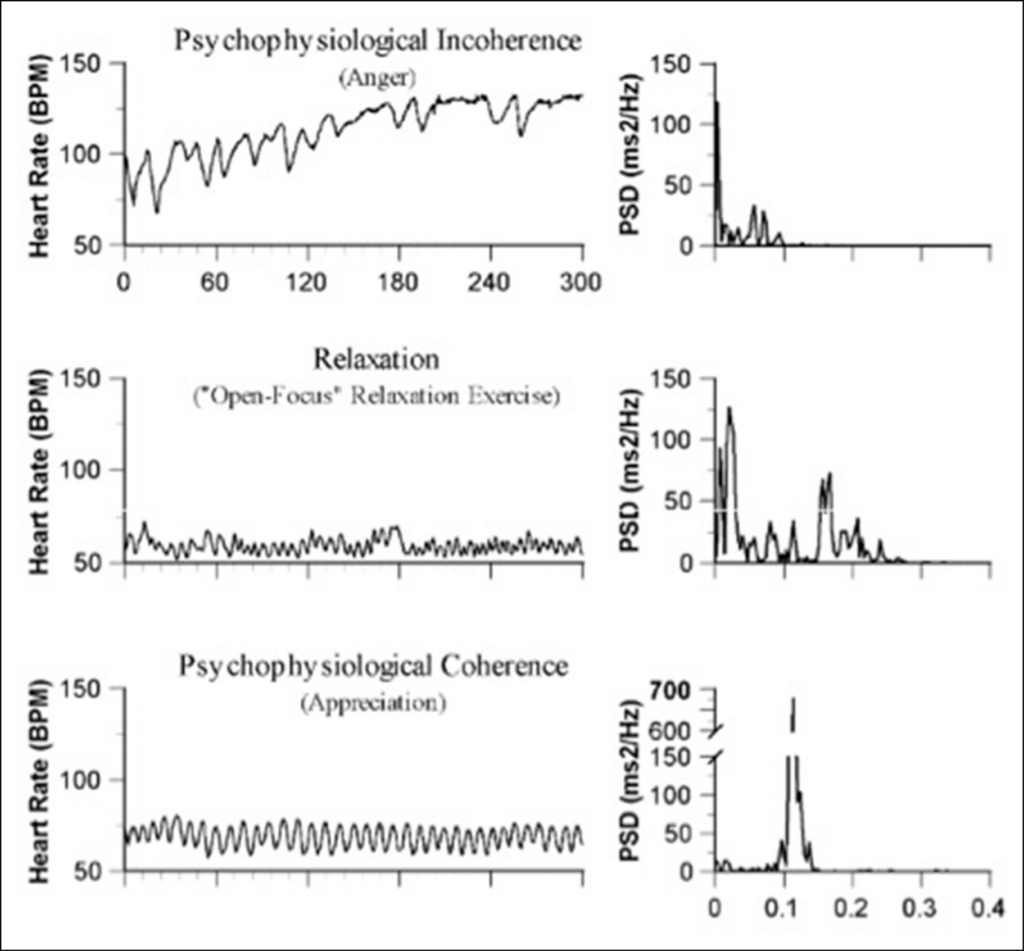
Figure 1. Heart rate variability tracings (left-side graphs) and power spectra (right-side graphs) demonstrating (A) Psychophysiological Incoherence as occurs when experiencing anger, (B) Relaxation, and (C) Psychophysiological Coherence as occurs when experiencing sustained regenerative emotions, such as appreciation. Psychophysiological incoherence is characterized by a lower frequency, more disordered heart rhythm pattern and increasing mean heart rate. The power spectra on the right shows this rhythm is primarily in the very low frequency range, which is typically associated with sympathetic nervous system activity. Relaxation results in a higher frequency, low amplitude rhythm indicating reduced autonomic outflow. Increased power in the high frequency range reflects increased parasympathetic activity. Psychophysiological coherence results in a highly ordered, sine wave-like heart rate variability pattern. According to the power spectra on the right, this rhythm corresponds with a large, narrow peak in the low frequency region, centered around 0.1 Hertz
Traditional therapies that focus primarily on cognitive restructuring can be valuable in addressing the emotional andcognitive aspects of dysregulation, helping individuals un-derstand and manage their thoughts, emotions, and behaviors. However, in a literature review, non-responsiveness to Cognitive Behavioral Therapy (CBT) for patients with PTSD was as a high as 50%.41 Cognitive therapies tend to engage the mind, sometimes overlooking the intertwined nature of mental, emotional and physiological dysregulation, sug-gesting a need for interventions that span all domains. When combined with CBT, HRV coherence biofeedback can pro-vide additional benefit by facilitating the acquisition of cognitive-based skills and regulating emotional and physi-ological function.42 Numerous studies have identified emo-tional and physiological dysregulation as clinical features of ACEs,43,44 childhood maltreatment,45 PTSD,46,47 and De-velopmental Trauma Disorder.48 Daily breathing practice aimed at generating the stable, high-amplitude oscillatory pattern characterized by coherence specifically targets dys-regulated HRV patterns, with studies demonstrating increased HRV and oscillatory amplitude (ie, coherence) following 4-6 weeks of coherence training.35–37 Clinically, these increases in HRV are associated with symptomatic improvements in emotional self-regulation, cognitive function, sleep and chronic pain.22 These findings are further supported by the neurovisceral integration model which describes how greater autonomic stability and flexibility, as evidenced by high resting HRV, increase the functional connectivity of emo-tional and cognitive brain regions through the vagus nerve and the central autonomic network.27,49,50 In this way, fo-cused attention to modify heart rhythm patterns through paced breathing and emotion self-regulation techniques can
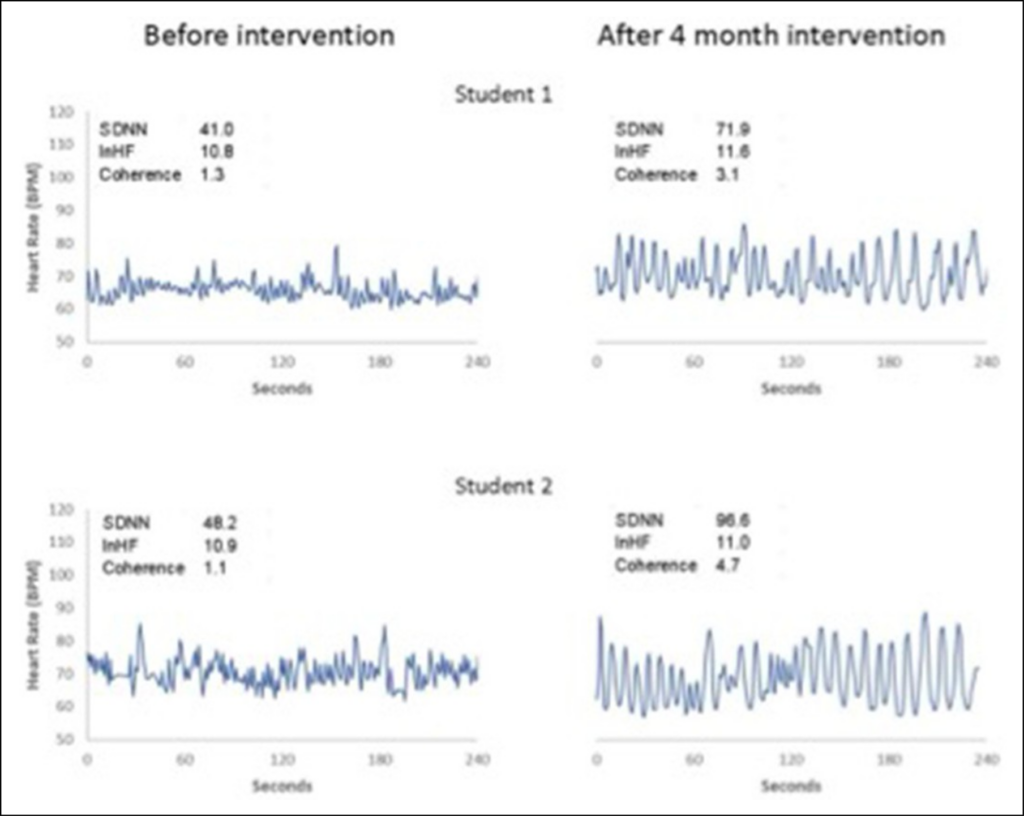
Figure 2. Resting-state heart rate variability (HRV) tracings of 2 subjects (“Student 1” and “Student 2”), taken at baseline (“Before intervention”) and 4-month after practicing HeartMath’s self-regulation techniques and HRV coherence biofeedback (“After 4 month intervention”). Qualitatively, baseline tracings are characterized by more chaotic or dysregulated HRV patterns, while follow-up tracings demonstrate increased amplitude and more ordered, coherent heart rhythm patterns. Qualitatively, an increase in HRV parameters is observed, including the standard deviation of inter-beat intervals (SDNN – an overall measure of HRV), high frequency power (lnHFP – a measure of vagally-mediated HRV) and Coherence (a measure of global synchrony that increases as the heart rate oscillates near the body’s natural cardiovascular frequency of approximately 0.1 Hz)
provide clear benefit to individuals who exhibit symptoms associated with physiological and emotional dysregulation. Emerging clinical studies on HeartMath techniques and HRV coherence biofeedback have demonstrated promising clinical outcomes, however further investigation is needed to assess their comparative efficacy alongside, or as an adjunct to, pharmacologic interventions. The focus on HRV quality and high-amplitude oscillatory patterns presents new avenues for research, and further exploration is needed to elucidate the mechanisms underlying these patterns and their impact on neurophysiological pathways. Finally, studies to date have been limited by relatively small sample sizes, and more detailed analyses of protocol parameters, implementation contexts, and cultural factors will be important to address in future systematic reviews.
Conclusion
The effects of chronic stress, trauma and adversity are reflected in the dysregulation of neuroendocrine and other physiological systems, contributing to a spectrum of physical and mental health issues across the lifespan. Heart rate variability has emerged as a valuable stress biomarker, of-fering insights into autonomic activity and its association with various mental and physical health conditions. The thera-peutic application of HRV coherence biofeedback presents a promising avenue for mitigating the clinical consequences of dysregulation, demonstrating efficacy in treating stress, anxiety, depression, and even chronic diseases. Regular practice using HRV coherence biofeedback and HeartMath’s self-regulation techniques over time can cultivate the state of coherence, establishing a new inner baseline that promotes physiological and emotional regulation, and a roadmap to greater health. Continued exploration of the mechanisms that underlie the physiological impact of coherence, and its long-term effects, will deepen our understanding of this inter-vention. Ultimately, the integration of HeartMath’s self-regulation techniques and HRV coherence biofeedback into therapeutic practices represents a noteworthy advancement, empowering individuals with a safe, non-invasive, and effective tool to enhance emotional and physiological well-being.
READ FULL ARTICLE WITH REFERENCES