

Can nature work to nurture our brains?
January 18, 2023 / lionstalkscience
By Alexandra Evans
https://lions-talk-science.org/2023/01/18/can-nature-work-to-nurture-our-brains/
Most Americans are guilty of it, but how much time do we spend staring at our screens throughout the day? A Nielson Total Audience Report published in 2017 determined that a majority of Americans spend approximately 10 hours a day staring at a screen, whether that be a computer, laptop, smartphone, or tablet.1 Additionally, there appears to be a global movement of people moving to urban environments as opposed to rural or suburban areas. The move to urban environments suggests that individuals are spending less of their time outdoors. Scientists propose that an increased amount of time spent in nature can contribute to psychological and emotional benefits (Figure 1).
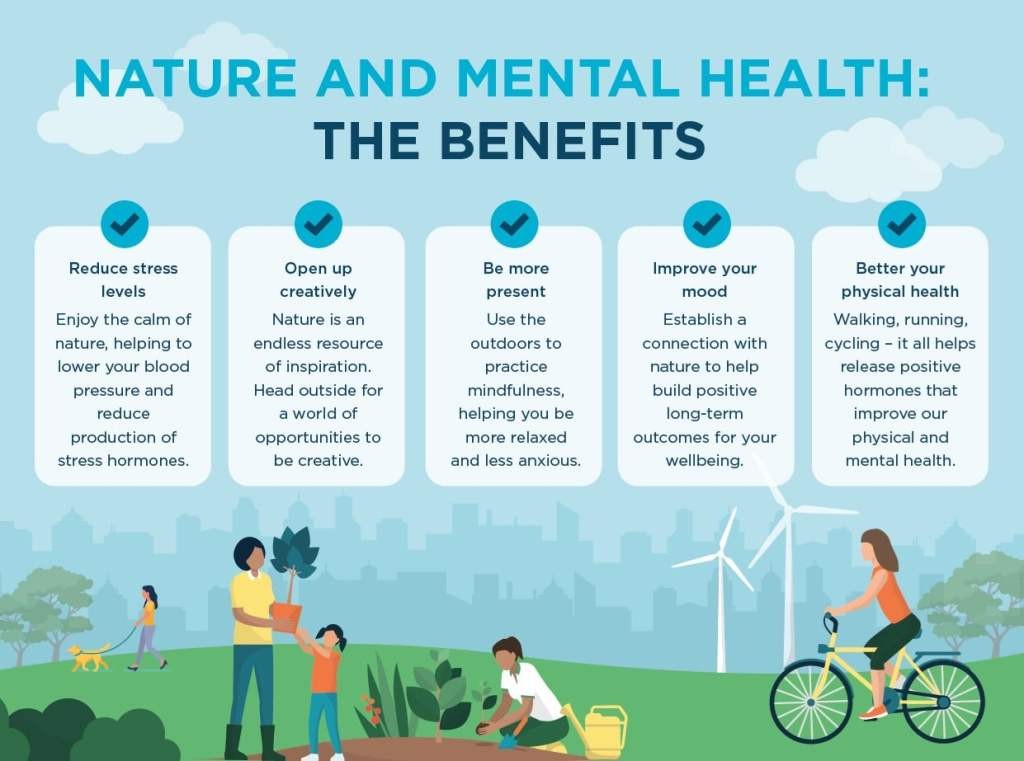
Figure 1. Mental health benefits associated with spending time in nature. Exposure to the outdoors increases the likelihood of reducing stress, promoting creativity, being present, improving overall mood, and bettering physical health.[3]
Within the last few years, virtual reality has become a big phenomenon. By using videos of nature, virtual reality could fill a need for individuals who lack access to the outdoors.7 Researchers studied exposure to nature by analyzing individuals who lived in either rural or urban environments after exposing these individuals to nature, whether this was in real life or using a video, respectively. Results from this study demonstrated that regardless of the source, researchers observed positive changes in participants when exposed to nature. For example, all participants exhibited increased attention spans and feelings of positive emotions, in which the in-person group experienced greater increases in attention span than the virtual group.6 Despite this difference, it is still noteworthy that virtual nature experiences benefited mental and emotional wellbeing.5
Not only are screen-based exposures to nature and green spaces beneficial, but auditory exposures to nature seem to provide a similar benefit.5 A recent study performed by Van Hedger and colleagues determined that individuals exposed to nature sounds such as ocean waves and the chirping of crickets scored higher on complex cognitive exams compared to individuals exposed to the sounds of heavy traffic and loud conversations.8 Nature also increases possible cognitive benefits such as improved cognitive development in school-aged children. Schools located near green spaces promote an increase in cognitive development amongst students.9,10 Children living in or around green spaces also exhibit a promotion in self-control behaviors. Generally speaking, increased exposure to the outdoors and green spaces leads to increases in working memory improvement and cognitive flexibility. Conversely, increased exposure to urban environments leads to increases in attention deficits and decreases in cognitive performance.10 Although SES was controlled for as a possible confounding variable, the researchers wondered if SES was a predictor of if individuals would participate in the study, suggesting that SES was a study limitation.9 Although a multitude of studies established the positive impact of nature on one’s overall wellbeing, one other question remains unanswered: what is the amount of time spent in nature that provides a therapeutic benefit?
Dr. Matthew White and colleagues sought to answer this question by sampling 20,000 adults in the United Kingdom (Figure 2). From this data set, White determined that individuals who spent two or more hours outside in nature, self-reported feelings of improved health and overall wellbeing.11 In particular, elder adults and those with chronic health issues benefitted from two or more recreational hours outdoors, suggesting that exposure to nature could serve as a possible treatment to the elderly and chronically ill populations. However, this question remains to be an avenue of future research.5
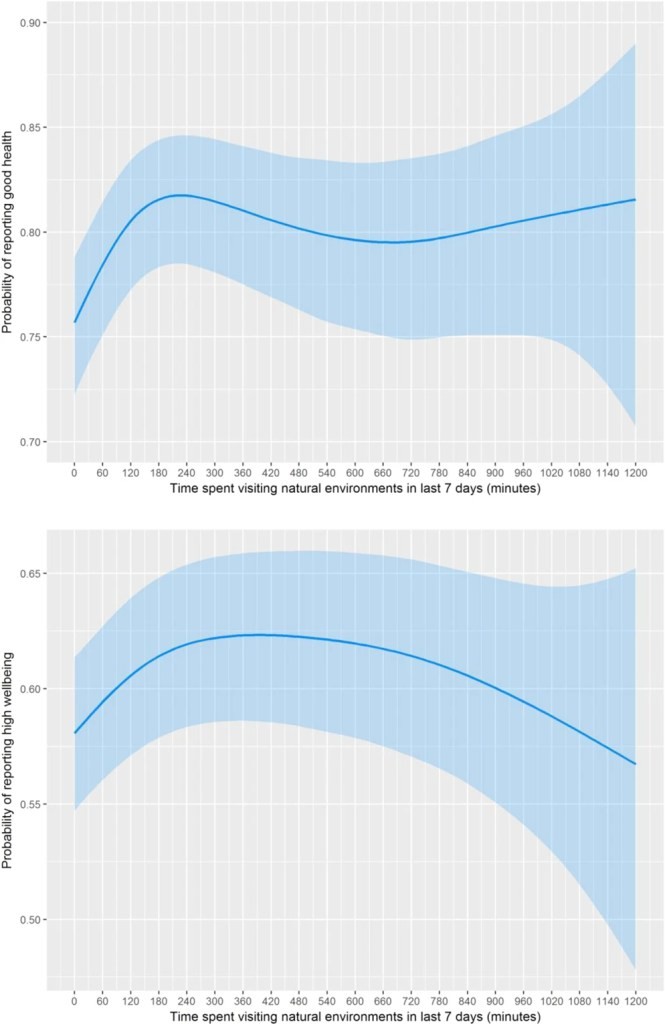
Figure 2. Probability of (a) reported good health and (b) high wellbeing versus time spent visiting natural environments in the last 7 days. Probability was determined using a generalized additive model that was adjusted for possible confounding variables such as urbanicity, sex, age, and neighborhood greenspace. Gradual increases can be observed for both panels, suggesting a positive relationship for good health and high wellbeing up to approximately 120 minutes per week.[11]
TL:DR
- Increased screen time combined with increased living in urban environments leads to less nature exposure.
- Exposure to nature and the outdoors increases the likelihood of increased mood, cognitive performance, memory, and less chances for development of psychiatric conditions.
- Virtual and auditory exposure to nature provides improvement to overall wellbeing, making nature more accessible to those in urban environments or individuals with disabilities.
References
- The Nielsen Total Audience Report. (2017). Retrieved December 13, 2022, from https://develop.nielsen.com/wp-content/uploads/sites/2/2019/04/q3-2018-total-audience-report.pdf
- Bratman, G. N., Anderson, C. B., Bergmen, M. G., Bobby, De Vries, S., Flanders, J., Folke, C., Frumkin, H., Gross, J. J., Hartig, T., Kahn, P. H., Kuo, M., Lawler, J. J., Levin, P. S., Lindahl, T., Meyer-Lindenberg, A., Mitchell, R., Ouyang, Z., Roe, J., … Daily, G. C. (2019). Nature and mental health: An ecosystem service perspective. Science Advances, 5(7). https://doi.org/10.1126/sciadv.aax0903
- Group, P. (2022). Nature and mental health. Priory. Retrieved December 13, 2022, from https://www.priorygroup.com/blog/nature-and-mental-health
- Engemann, K., Pedersen, C. B., Arge, L., Tsirogiannis, C., Mortensen, P. B., & Svenning, J.-C. (2019). Residential green space in childhood is associated with lower risk of psychiatric disorders from adolescence into adulthood. Proceedings of the National Academy of Sciences, 116(11), 5188–5193. https://doi.org/10.1073/pnas.1807504116
- Weir, K. (2020, April 1). Nurtured by nature. Monitor on Psychology. Retrieved December 14, 2022, from https://www.apa.org/monitor/2020/04/nurtured-nature
- Mayer, F. S., Frantz, C. M. P., Bruehlman-Senecal, E., & Dolliver, K. (2008). Why is nature beneficial? Environment and Behavior, 41(5), 607–643. https://doi.org/10.1177/0013916508319745
- White, M. P., Yeo, N., Vassiljev, P., Lundstedt, R., Wallergård, M., Albin, M., & Lõhmus, M. (2018). A prescription for “nature” – the potential of using virtual nature in Therapeutics. Neuropsychiatric Disease and Treatment, Volume 14, 3001–3013. https://doi.org/10.2147/ndt.s179038
- Van Hedger, S. C., Nusbaum, H., Clohisy, L., Jaeggi, S. M., Buschkuehl, M., & Berman, M. (2018). Of cricket chirps and car horns: The effect of nature sounds on cognitive performance. https://doi.org/10.31234/osf.io/f5hcz
- Dadvand, P., Nieuwenhuijsen, M. J., Esnaola, M., Forns, J., Basagaña, X., Alvarez-Pedrerol, M., Rivas, I., López-Vicente, M., De Castro Pascual, M., Su, J., Jerrett, M., Querol, X., & Sunyer, J. (2015). Green spaces and cognitive development in primary schoolchildren. Proceedings of the National Academy of Sciences, 112(26), 7937–7942. https://doi.org/10.1073/pnas.1503402112
- Schertz, K. E., & Berman, M. G. (2019). Understanding nature and its cognitive benefits. Current Directions in Psychological Science, 28(5), 496–502. https://doi.org/10.1177/0963721419854100
- White, M. P., Alcock, I., Grellier, J., Wheeler, B. W., Hartig, T., Warber, S. L., Bone, A., Depledge, M. H., & Fleming, L. E. (2019). Spending at least 120 minutes a week in nature is associated with good health and Wellbeing. Scientific Reports, 9(1). https://doi.org/10.1038/s41598-019-44097-3
- Gascon, M., Zijlema, W., Vert, C., White, M. P., & Nieuwenhuijsen, M. J. (2017). Outdoor Blue Spaces, human health and well-being: A systematic review of Quantitative Studies. International Journal of Hygiene and Environmental Health, 220(8), 1207–1221. https://doi.org/10.1016/j.ijheh.2017.08.004