

Creatine supplementation for brain metabolic stress: a narrative review
Darren G. Candow1,*, Terence Moriarty2 , et al
Academia Neuroscience and Brain Research, May 26, 2026
Abstract
The brain accounts for approximately 2% of the total body mass yet it consumes about 20% of the daily energy expenditure. These energetic demands are further elevated during periods of metabolic stress, including sleep deprivation, hypoxia, forced mental fatigue, mood disorders, and traumatic brain injury (TBI). Creatine monohydrate supplementation (CrM) plays a critical role in brain bioenergetics via the phosphocreatine (PCr) energy system, which acts as a spatial and temporal buffer by rapidly regenerating adenosine tripho sphate (ATP) from adenosine diphosphate (ADP). Accordingly, CrM has been proposed as a potential neuroprotective intervention, particularly under conditions of metabolic stress. This narrative review examines both the mechanistic rationale and empirical evidence supporting this role. CrM has been shown to increase brain creatine content by 3–10%, enhance PCr availability, stabilize intracellular pH, and support mitochondrial function. These physiological effects are associated with attenuated cognitive declines during acute sleep deprivation and hypoxia, improved executive function under forced mental fatigue, and reduced depressive symptoms, especially when used adjunctively with standard therapies. In the context of TBI, preclinical studies in rodents demonstrate reduced cortical damage and improved bioenergetics, while limited but promising pediatric clinical data suggest improved recovery outcomes with CrM supplementation. Collectively, the existing body of research indicates that CrM can enhance brain creatine content and bioenergetic capacity, which is associated with improvements in cognitive function. Despite these promising findings, the current
body of evidence remains limited. Large, well-designed randomized controlled trials are needed to establish optimal dosing strategies, determine population-specific efficacy, and evaluate long-term neurological outcomes associated with CrM supplementation.
The brain is relatively small in stature, representing 2% of the total body mass, but it can consume approximately 20% of the daily energy expenditure during periods of metabolic stress (i.e., sleep deprivation, hypoxia, forced mental fatigue, mood disor-ders, traumatic brain injury (TBI)) [1–5]. Although mechanis-tically distinct, a commonality amongst these stressors involves destabilization of adenosine triphosphate (ATP) homeostasis [6]. Creatine (α-methylguanidinoacetic acid) plays a central role in cerebral bioenergetics [7]. Acting as both a temporal and spatial high-energy phosphate buffer, phosphocreatine (PCr) donates a phosphate group to adenosine diphosphate (ADP) during periods of increased demand, thereby stabilizing intracellular ATP con-centrations [8]. Under conditions of acute metabolic stress, this buffering system becomes even more important. Creatine mono-hydrate (CrM) increases PCr availability, which may attenuate ATP depletion during periods of metabolic stress and thereby sta-bilize mitochondrial function and reduce oxidative stress [4–6, 9]. Although cerebral uptake of creatine appears regulated, CrM has been shown to increase brain creatine levels in several stress-related conditions [1]. Notably, CrM does not uniformly increase brain creatine levels across all conditions [1]. Efficacy appears context-dependent, and potentially influenced by metabolic stress burden. CrM may be most effective in scenarios characterized by transient brain bioenergetic insufficiency, often observed during prolonged wakefulness, circadian disruption, hypoxic exposure, intense cognitive demand, trauma, or psychological stress [1–6], as shown in Figure 1. Therefore, the purpose of this brief narra-tive is to examine the potential of CrM as a potential neuroprotec-tive intervention, particularly under conditions of metabolic stress (Table 1).
2. Creatine and sleep deprivation
2.1. Energy homeostasis
Periods of cognitive [10] or physical stress [11], including sleep deprivation [12], can impact the energetic status of the brain. Sleep deprivation represents a potent and pervasive metabolic stressor for the brain, impairing cognitive performance, executive function, reaction time, and emotional regulation [12–14]. These impairments are particularly relevant to operational populations
including shift workers, military personnel, athletes or business travelers undergoing trans-meridian travel, long-distance drivers, and firefighters and healthcare providers exposed to acute circadian disruptions. The neurobiological basis of cognitive decline secondary to sleep deprivation is strongly linked to impaired cerebral energy metabolism, reductions in ATP availability, increased reliance on anaerobic pathways, and altered neurotransmission [15, 16]. CrM has emerged as a potential nutritional intervention capable of mitigating these effects through its role
in maintaining brain bioenergetic homeostasis and supporting neuronal function during periods of energetic stress [5].
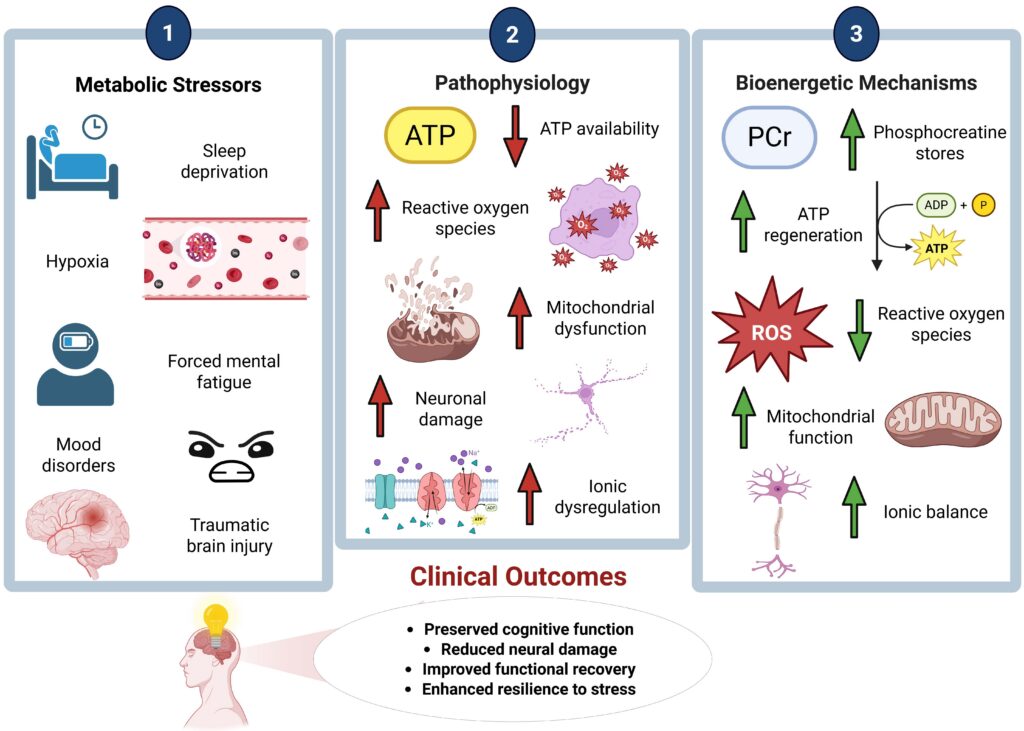
Figure 1 • A schematic representation showing the metabolic stressors, pathophysiology, and purported mechanisms whereby creatine supplementation may alter cognitive function. ROS: reactive oxygen species; ADP: adenosine diphosphate; ATP: adenosine triphosphate, P: inorganic phosphate. Created in BioRender. Specht, J. (2026) https://BioRender.com/zfij3li
Table 1 • Creatine supplementation across metabolic stress conditions.
| Condition | Primary metabolic stress | Mechanistic role of creating | Key outcomes |
| Sleep deprivation
|
Reduced ATP and mitochondrial inefficiency | Increased PCr buffering; reduces homeostatic sleep pressure by altering adenosine accumulation | Attenuated decline in executive function, processing speed, reaction time, and mood |
| Hypoxia | Limited/reduced O2 leading to anaerobic shift and ROS accumulation | Facilitates spatial and temporal ATP buffering independent of oxidative phosphorylation | Preserved cognitive performance and increased corticomotor excitability |
| Forced mental fatigue | Increased ATP demand mismatching resynthesis capacity | Rapid ATP resynthesis to maintain neuronal activation during high cognitive demand | Reduced subjective mental fatigue and improved Stroop task accuracy |
| Mood disorders
|
Mitochondrial pathology and decreased PCr | Helps to restore bioenergetic capacity and support PFC functioning | Reduction in overall depressive symptoms and inverse correlation between PFC PCr concentrations and depression scores |
| Traumatic brain injury
|
Bioenergetic crisis, increased ROS and excitotoxicity, Ca2+ dysregulation | Stabilizes ATP, reduces ROS, preserves mitochondrial function | Decreased cortical damage and improved functional recovery |
2.2 Creatine and brain energy metabolism during sleep deprivation
Creatine functions as a critical component of the PCr system, which buffers intracellular ATP concentrations by rapidly regen-erating ATP from ADP via the creatine kinase reaction [17]. This mechanism is especially important in tissues with high and fluc-tuating energy demands, including the brain. Creatine facilitates ATP recycling and energy transport, thereby stabilizing neuronal bioenergetics under conditions of increased metabolic stress [18]. Sleep deprivation imposes a substantial energetic burden on re-gions of neural tissue regions responsible for executive control, working memory, and attention (i.e., the prefrontal cortex, hip-pocampus, basal forebrain [12, 14]). Prolonged wakefulness in-creases neuronal energy demand while impairing mitochondrial efficiency and reducing ATP availability [13]. These effects con-tribute to cognitive fatigue, impaired executive function, and di-minished vigilance. In 1999, Dechent et al. [19] reported for the first time that a single 20 g dose of CrM could increase total brain creatine levels for up to 8.5 h. Since that time, multiple studies have highlighted that CrM can increase brain creatine content by 3–10% [19–26].
CrM has been shown to increase brain creatine and PCr concen-trations, enhancing the brain’s capacity to buffer ATP depletion and maintain neuronal function under metabolically challenging conditions [19, 25, 27]. For example, Turner and colleagues [25] showed that seven days of CrM could positively impact atten-tional capacity and corticomotor excitability during a period of metabolic stress. In 2024, Gordji-Nejad et al. [27] used phospho-rus magnetic resonance spectroscopy (MRS) to evaluate the ability of a single high dose (0.35 g/kg) of CrM during 21 h of sleep deprivation to impact cognitive performance and brain energy content. CrM significantly improved PCr-to-inorganic phosphate ratios, preserved ATP levels, and prevented reductions in brain pH, demonstrating improved cellular bioenergetics during sleep loss. In addition to energy buffering, CrM may also support neu-ronal membrane integrity, calcium homeostasis, and mitochon-drial function [28]. A more recent follow-up investigation from the same research group provided additional evidence for CrM to harmonize cerebral energy disturbances during periods of dis-rupted sleep. Again, a single dose (0.35 g/kg) of CrM balanced the hemispheric asymmetry in energetic compounds secondary to sleep deprivation [29]. Further, experimental evidence indicates that CrM improves neuronal resistance to energetic stress and oxygen deprivation by maintaining ATP availability independent of oxidative phosphorylation [25]. This mechanism is particularly relevant during sleep deprivation, when mitochondrial function may be transiently impaired and energy demand exceeds aerobic supply.
2.3. Effects of creatine on sleep homeostasis and neurochemical regulation
CrM may also influence sleep regulation itself. Dworak and in-vestigators [30] studied the impact of CrM on sleep homeostasis in rats and demonstrated that CrM reduces homeostatic sleep pressure and attenuates compensatory rebound sleep following sleep deprivation. Changes in extracellular adenosine accumula-tion, an important regulator of sleep metabolism and indicator of cellular energy depletion, were improved by CrM. Through improved maintenance of ATP availability and reduced ADP ac-cumulation, CrM may exert influence over adenosine formation, which can subsequently go on to decrease the physiological drive for sleep [30]. Mechanistically, these results have important im-plications for individuals exposed to sleep disruption due to occu-pational or environmental factors, such as shift workers, firefight-ers [31], healthcare providers [32], or long-haul travelers. By sta-bilizing cellular energy metabolism and reducing sleep pressure, CrM may help sustain cognitive performance and alertness during periods of insufficient sleep.
2.4. Effects of creatine on cognitive function during sleep deprivation
Several controlled human studies have demonstrated that CrM can attenuate cognitive impairments induced by sleep depriva-tion [27, 33–35]. Evidence from early randomized controlled trials highlight that CrM loading (20 g/day for 7 days) significantly re-duced the deterioration in cognitive performance associated with 24–36 h of sleep deprivation [33, 34]. Specifically, CrM attenuated declines in random movement generation, choice reaction time, and balance, and preserved mood state relative to placebo [34]. These tasks rely heavily on prefrontal cortex function and exec-utive control processes, suggesting that CrM may preferentially support higher-order cognitive functions under energetic stress. A follow-up investigation confirmed these findings, whereby CrM significantly improved central executive task performance after 36 h of sleep deprivation compared to placebo [33]. Notably, the CrM group exhibited progressive improvement in executive function performance throughout the sleep deprivation period, whereas the placebo group showed no such adaptation. These findings provide strong evidence that CrM enhances cognitive resilience during prolonged wakefulness, particularly for tasks requiring sustained attention and executive processing. As previ-ously discussed, a single, large (0.35 g/kg) dose of CrM has been shown to exert a positive impact on cognitive performance 3–7.5 h after ingestion following a 21 h period of sleep deprivation [27]. Importantly, these outcomes provide meaningful functional ex-planations for the previously mentioned increases in brain energy reserves in this study. Collectively, these findings indicate that CrM may provide both acute and chronic neuroprotective effects against sleep deprivation-induced cognitive decline.
2.5 Looking ahead: relevance to operational, clinical, and athletic populations
The neuroprotective and bioenergetic properties of CrM have clear implications for populations exposed to sleep deprivation and circadian disruption. These include military personnel, health-care workers, shift workers, airline crews, over-the-road drivers, ultra-endurance/expedition athletes, and individuals undergoing trans-meridian travel (i.e., athletes and business executives). In these contexts, sleep deprivation is often unavoidable, and in-terventions that preserve cognitive performance and executive control are critical for safety, performance, and decision-making. Cook and colleagues [36] had ten elite rugby players supplement with either placebo or creatine at dosages of either 50 mg/kg or 100 mg/kg in combination with acute sleep restriction (3–5 h of sleep) while completing a passing skill test. Sleep deprivation re-sulted in significant reductions in passing accuracy while creatine supplementation at either dose mitigated the observed decrease in passing performance. Other studies outside of sleep deprivation support the potential of CrM to support sleep habits in exercising individuals. Briefly, Cruz et al. [37] supplemented 21 healthy, exercising females for six weeks with either creatine monohydrate or placebo (5 g/day) and reported that CrM increased total sleep duration on the days a workout was completed. More recently, researchers supplemented 14 active men with either creatine monohydrate or placebo at a dosage of 20 g per day for 7 days while evaluating their sleep, cognitive, and physical performance. When CrM was provided, sleep quality was improved alongside selected improvements in both cognitive and physical performance [35]. Collectively, these findings suggest that CrM can improve sleep habits while also preserving skill performance in athletes during acute periods of sleep restriction while also supporting various cognitive domains most vulnerable to sleep deprivation, including executive function, reaction time, and mental processing speed. These effects appear to be most pronounced when brain bioener-getics are challenged, such as during trans-meridian travel, jet lag, high training loads, and circadian disruptions, rather than under normal resting conditions.
Sleep deprivation imposes a significant metabolic challenge to brain function, impairing cognition, executive control, and vigi-lance through mechanisms involving ATP depletion, mitochon-drial dysfunction, and altered neurotransmission. CrM provides a mechanistically plausible and increasingly supported interven-tion for mitigating these effects. By enhancing brain PCr avail-ability, stabilizing ATP concentrations, reducing sleep pressure, and supporting neuronal energy metabolism, CrM may preserve cognitive performance during acute sleep deprivation. To date, human experimental studies have demonstrated that CrM atten-uates declines in executive function, processing speed, reaction time, and athletic skill performance during sleep deprivation, with effects most pronounced under conditions of energetic stress. These findings support the potential utility of CrM as a neuro-protective and cognitive-supportive intervention for individuals exposed to sleep disruption, including shift workers, travelers, athletes, and operational populations. Continued research is war-ranted to further define optimal dosing strategies, timing, and population-specific effects, but current evidence provides prelim-inary support for creatine as a promising countermeasure to acute sleep deprivation-induced cognitive impairment.
3. Creatine and hypoxia
Acute cerebral hypoxia imposes a significant energetic challenge on the brain, an organ characterized by high metabolic demand, limited ATP reserves, and a high reliance on oxidative phosphory-lation. At the cellular level, exposure to low oxygen content rapidly compromises ATP production with a shift towards anaerobic sub-strate utilization. This metabolic stress promotes reactive oxygen species (ROS) and the accumulation of anaerobic by-products (e.g., lactate and pyruvate), while simultaneously destabilizing membrane potentials, often leading to excitotoxic cascades [38]. In this state of perturbed bioenergetics, the PCr system may serve as an immediate ATP buffer, sustaining cellular ATP produc-tion during periods of elevated metabolic demand (e.g., hypoxia) when oxidative metabolism is constrained [39]. Beyond temporal buffering, the PCr system facilitates spatial energy transfer, shut-tling high-energy phosphates from mitochondria to distal sites of ATP use to maintain ion homeostasis. Evidence from a perinatal large-animal model of hypoxia–ischemia demonstrates that the PCr recovery response may also serve as a biomarker of metabolic resilience. The capacity for PCr to recover and specifically ‘over-shoot’ baseline levels within 2–8 h post-insult was strongly as-sociated with a favorable clinical outcome [40]. This overshoot likely reflects a compensatory metabolic response associated with improved recovery of high-energy phosphate metabolism.
Preclinical stroke studies provide proof of principle that increas-ing the creatine pool can be neuroprotective [41, 42]. For example, Zhu and colleagues [41] were the first to provide evidence of a direct relationship between the preservation of bioenergetic cellular status and the inhibition of the activation of caspase cell-death pathways in vivo. Specifically, they demonstrated that prophylactic CrM reduced infarct volume after middle cerebral ischemia, reduced cytochrome-c release and caspase-3 activation, and buffered ischemia-mediated cerebral ATP depletion. Subse-quently, Prass et al. [42] extended these findings by demonstrat-ing that CrM-mediated neuroprotection can occur independent of changes in the bioenergetic status of brain tissue but may involve improved cerebrovascular function (as seen by augmented cerebral blood flow and improved vasodilatory responses after stroke in CrM-treated mice). Therefore, these findings support the concept that increasing creatine stores prior to an ischemic insult may enhance tolerance to acute energy deprivation through complementary mechanisms involving both cellular energy stabi-lization and enhancement of cerebrovascular function.
Human data in this area remains limited but mechanistically focused review articles converge on additional protective effects of CrM under hypoxia/ischemia, including the mitigation of in-tracellular acidosis, membrane stabilization, and redox buffer-ing, all features consistent with restoring cellular bioenergetic homeostasis [39]. In a randomized crossover study by Turner and colleagues [25], short-term CrM (20 g/day for 7 days) increased total brain Cr (~9%) and preserved attentional performance in adults during hypoxic conditions (10% oxygen for 90 min). This was accompanied by increased corticomotor excitability. These findings are consistent with the hypothesis that increasing brain creatine stores may help sustain neural responsiveness and re-store hypoxia-induced decrements in cognitive performance when oxygen delivery is reduced.
In summary, convergent mechanistic evidence, strong preclinical ischemia data, and early human research under hypoxia or acute energy stress support the concept that cerebral creatine availabil-ity is mechanistically coherent and translationally promising in the context of hypoxic stress. Future studies should pair standard-ized high-demand cognitive testing with in vivo MRS to uncover any potential metabolic effects of CrM.
4. Creatine and forced mental fatigue
While hypoxia represents an external constraint on energy sup-ply, forced mental fatigue represents an internal surge in energy demand. Sustained high-intensity cognitive effort, such as the Stroop or N-back test, increases neuronal ATP turnover. Under these conditions, cognitive fatigue, often experienced as mental exhaustion and reduced performance, may reflect a transient mismatch between ATP demand and mitochondrial resynthesis capacity. Therefore, the PCr system may function as an immediate energy reserve, allowing the rapid resynthesis of ATP and helping maintain neuronal activation during prolonged mental effort.
Recent evidence related to cognitive functioning suggests that CrM produces small but measurable benefits in memory and select attention or processing speed outcomes, with larger and more consistent effects in situations characterized by bioenergetic constraint [43]. Tasks requiring rapid processing speed or heavy working memory loads are particularly sensitive to improved phosphagen buffering, supporting a model of cognitive resilience rather than global enhancement. Specific to forced mental fa-tigue, Watanabe et al. [44] demonstrated that CrM (8 g/day for 5 days) reduced subjective mental fatigue during repeated mental arithmetic calculations and was associated with increased cerebral oxygen utilization. More recently, Van Cutsem et al. [45] examined the effects of CrM (20 g/day for 7 days) in healthy adults on psychomotor performance, and cognitive performance following a 90 min mental fatigue-inducing Stroop task. Although CrM improved prolonged cognitive performance (Stroop accuracy), it did not prevent fatigue-induced declines in psychomotor per-formance [45]. The authors attributed these mixed findings to potential influences of motivation, dosage, supplementation du-ration, or insufficient task complexity. In addition, interindividual variability may reflect differences in baseline brain creatine levels, SLC6A8 function, age, and the complexity of metabolic stress imposed by the task.
From a practical perspective, available evidence suggests that chronic CrM (4 g/day for ≥4 weeks) may be required to signifi-cantly elevate brain Cr stores [1, 4, 5, 46], allowing adequate time for brain creatine levels to overcome the limited transport capacity of the blood–brain barrier. When cerebral creatine stores are saturated, the PCr pool serves as an energetic reservoir, equipping the brain to navigate metabolically demanding scenarios, whether induced by hypoxia or prolonged mental effort.
5. Creatine and mood disorders
Altered bioenergetics in the brain can therefore potentiate symp-toms of mental disorders such as depression. Major depressive disorder (MDD) and depressive symptoms include low mood or anhedonia, sleep disturbances, concentration difficulties, and de-creased energy. During a depressive episode, the brain is under higher metabolic demand related to mitochondrial pathology, in-cluding changes in the oxidative phosphorylation and mitochon-drial proliferation. The prolonged metabolic stress depletes brain phosphocreatine stores, which forces cells to rely on slower gly-colysis pathways, leading to mitochondrial dysfunction and brain pathology. As such, bioenergetic compounds such as creatine may have potential in this area [1].
The maintained altered brain bioenergetics may perpetuate de-pressive mood, which in turn further depletes brain creatine stores—leading to a cycle of a metabolically demanding state [47]. This is evident from depression scores, which have been associ-ated with concentrations of creatine in the prefrontal cortex [48]. While dietary creatine has been associated with an inverse step-wise association with depression, CrM is able to provide much higher relative doses as compared to diet alone [49]. These higher doses may be necessary to cause meaningful increases in brain cre-atine levels and thus exert its therapeutic effects [2]. To date, four randomized controlled trials have investigated the effects of CrM in the treatment of MDD [3]. All four studies found a decrease in depressive symptoms after CrM. Lyoo et al. found that adjunctive CrM with escitalopram caused a greater reduction in depressive symptoms as measured by the Hamilton Rating Scale for Depres-sion (HAM-D; CrM = 5.4 ± 3.0, placebo = 9.8 ± 3.5; Cohen’s d = 1.13), Montgomery–Åsberg Depression Rating Scale (MADRS; z =−3.55), and Clinical Global Impression severity subscale (CGI-S; z = −3.89) [50]. Using proton magnetic resonance spectroscopy on a subset of participants receiving CrM and antidepressant medi-cations, Yoon et al. [51] found a negative correlation between de-pressive symptoms and prefrontal N-acetylasparatate (a marker of mitochondrial function and neuronal viability) (Spearman’s rho = −0.49, p = 0.004) [51]. Furthermore, Kondo et al. [52] found that prefrontal PCr concentrations were inversely corre-lated with depression scores (p = 0.02) in people with depression receiving CrM and antidepressant medications [52]. The find-ings from Yoon et al. and Kondo et al. further strengthen the relationship between depressed mood states and mitochondrial dysfunction in the brain that can be potentially treated with CrM. The reductions in depressive symptoms were similarly found by Toniolo et al. [53], who investigated the usage of CrM in bipolar depression [53]. However, this was found to not be statistically significant (p = 0.560; Cohen’s d = 0.231). Additionally, 2 out of 17 participants in the CrM group experienced a manic switch and another experienced a hypomanic switch.
Individuals with depression struggle with negative cognition of the self, world, and future that becomes rigid, inflexible, and distorted. Psychotherapy, more specifically, cognitive behavioral therapy (CBT), seeks to teach individuals to identify, challenge, and replace these negative cognitive states with more adaptive and balanced perspectives. However, the ability to engage in psy-chotherapy requires higher-level cognitive processes such as com-plex meta-conscious activities (awareness of the content in one’s consciousness) and insight formation requires a significantly higher energy demand on the brain than simple sensory processes or brainstem functions [54]. These higher-order brain activities require more spatiotemporal coordination among neurons in dis-parate brain regions that have higher energetic demands on the brain [55]. At times, during a major depressive episode, cognition can become profoundly impaired, which affects one’s ability to en-gage in therapy effectively. However, CrM may address this energy and cognitive gap. A randomized controlled trial in middle-aged adults with MDD who had discontinued pharmacotherapy for >8 weeks found that CrM (5 g/day for 8 weeks) combined with CBT had a greater decrease in depressive scores compared to placebo as measured by Patient Health Questionnaire 9 (PHQ-9) scores (CBT + CrM = 5.8 ± 4.8, CBT + placebo = 11.9 ± 6.6; p < 0.05) [56]. In this context, CrM may help buffer neuronal energy demands, which would allow for the return of meta-conscious activities and insight development for deeper self-awareness and therapeutic insight that can be achieved through psychotherapy.
Overall, converging evidence suggests that depression is charac-terized by a metabolically stressed brain state marked by mito-chondrial dysfunction, depleted PCr reserves, and impaired ox-idative phosphorylation [47]. This is manifested clinically as low mood, cognitive rigidity, fatigue, and executive dysfunction. CrM appears to partially restore brain bioenergetic capacity, particu-larly within the prefrontal cortex network, which is involved in executive control, metacognition, and therapeutic engagement. Studies have shown improvements in depressive symptoms, pro-cessing speed, and treatment responsiveness that correlates with increases in brain PCr, supporting a mechanistic link between brain bioenergetics and depression. This brain creatine deficiencymay represent a transdiagnostic factor across mood disorders, whereby CrM can serve as a therapeutic intervention to counteract this acute or chronic metabolic stressor.
6. Creatine and traumatic brain injury
TBI represents a major public health concern and is associated with acute and chronic neurological impairments resulting from both primary mechanical insult and secondary metabolic dysfunc-tion. The primary insult is thought to be the diffuse stretching of axons by internal shear and strain forces [57] and although these forces may not cause immediate axonal disconnection or swelling [58], they may induce secondary damage via a pro-nounced bioenergetic crisis [59]. This bioenergetic cascade may ultimately lead to axons that remain intact but are functionally impaired, with altered conduction velocities [58]. In brief, there is an increase in intracellular calcium and sodium as well as extra-cellular potassium, which leads to nonspecific membrane depolar-ization and indiscriminate release of excitatory neurotransmitters (e.g., glutamate) [60]. It is these neurotransmitters that cause an altered feedback loop and excessive use of ATP-dependent ionic pumps to try and regain resting membrane potential. This process results in a cellular energy crisis. In parallel, increased production of reactive oxygen species (ROS) promotes lipid peroxidation, cytoskeleton damage, and further mitochondrial damage, as well as possible apoptosis [61]. Nutritional interventions targeting cerebral energy metabolism have therefore emerged as potential therapeutic strategies to target several of these interconnected pathways. Among these, CrM has received growing attention due to its role in cellular energy buffering and neuroprotection.
Approximately 95% of the total body creatine is stored in skele-tal muscle, while smaller but physiologically important concen-trations are present in brain tissue [62]. In neural cells, criti-cally for the case of TBI, CrM enhances the capacity for rapid ATP resynthesis without the need for oxygen, thereby helping to reduce the generalized cellular energy crisis. Specifically, this preservation of ATP supports Na+/K+-ATPase function and helps maintain membrane potential, indirectly reducing excitotoxic sig-naling. The tight coupling of creatine and ATP in mitochondria may also decrease the formation of ROS, thereby having an an-tioxidant effect [58, 60]. Furthermore, CrM stabilizes mitochon-drial creatine kinase in its octameric form, which helps prevent the opening of the mitochondrial permeability transition pore (mPTP). In turn, this reduces the likelihood of pro-apoptotic factors such as cytochrome-c being released into the cytosol to induce apoptosis [8], thereby mitigating secondary tissue damage and preserving bioenergetic flux. Finally, there is some evidence that CrM may act as a neurotransmitter and decrease neuronal loss via interaction with N-methyl-D-aspartate receptors and have an agonist effect on GABA receptors [28]. All in all, PCr acts as an energy reserve that stabilizes ATP availability during periods of metabolic stress, suggesting a mechanistic rationale for creatine supplementation following TBI.
6.1. Animal evidence
Experimental animal models provide the strongest support for CrM having neuroprotective effects. In a landmark study, Sullivan et al. [63] showed that mice who ingested a creatine-enriched diet (3 mg/g of body weight) for 3 and 5 days prior to experimental TBI experienced a significant reduction in cortical damage, by 21–36%, compared to mice on a creatine-free diet. Further, rats who ingested the same creatine dosage for 40 days prior to TBI ex-perienced a 50% reduction in cortical damage compared to rats fed a creatine-free diet. Mechanistically, the authors attributed these findings to improved mitochondrial function and preservation of brain bioenergetics. Subsequent investigations have confirmed that CrM attenuates oxidative stress markers, reduces lipid per-oxidation, and improves mitochondrial efficiency following brain injury [64]. Furthermore, CrM appears to mitigate several com-ponents of the secondary injury cascade. Proposed mechanisms include the maintenance of intracellular ATP, buffering of calcium homeostasis, stabilization of mitochondrial membranes, and re-duction in reactive oxygen species production [5, 65]. Collectively, animal findings consistently demonstrate metabolic protection.
6.2. Human clinical evidence
Despite robust experimental data, clinical research examining CrM in TBI populations remains limited. The most notable hu-man investigation is a pilot clinical study conducted by Sakellaris et al. [66, 67], which examined CrM in children and adolescents with moderate to severe TBI. Participants received CrM (0.4 g·kg−1·day−1) for six months during rehabilitation. Compared with standard care, CrM was associated with a reduced duration of post-traumatic amnesia, shorter intensive care unit stays, and improvements in cognitive and functional outcomes, including communication, self-care, and locomotor abilities. Importantly, no adverse effects were reported, supporting the safety of CrM in this population. Although promising, these findings should be interpreted cautiously due to the small sample size and lack of large randomized controlled trials. To date, comparable studies in adult TBI populations are lacking, limiting generalizability across age groups and injury severities.
Overall, the existing literature suggests that CrM is biologically plausible as a neuroprotective strategy following TBI. Preclin-ical evidence consistently demonstrates reduced tissue damage and improved cellular energetics, while early clinical findings indicate potential functional benefits. However, the absence of large, well-controlled human trials represents a critical limitation. Future research should prioritize randomized controlled trials in adult and athletic populations, standardized dosing protocols, and long-term neurological outcomes.
7. Conclusions
Disturbances in cerebral bioenergetics represent a common physiological denominator across a wide range of acute metabolic stressors including sleep deprivation, hypoxia, forced mental fatigue, mood disorders, and TBI, as shown in Table 1. In each of these conditions, the brain experiences either an increase in ATP demand or reduction in ATP supply, resulting in transient or sustained destabilization of ATP homeostasis. CrM represents a potential nutritional strategy to counteract these disturbances by influencing high-energy phosphate kinetics, mitochondrial sta-bility, and neuronal energy metabolism. Although the body of research is small and characterized by numerous methodological limitations, human studies to date demonstrate that CrM can increase regional and total brain creatine levels and cognitive performance during episodes of acute sleep deprivation, hypoxic exposure, and sustained mental effort. Further, emerging clinical research suggests that CrM has therapeutic effects for various mood disorders and TBI. Importantly, the magnitude of these effects appears context-specific, with the vast majority of benefits observed under conditions characterized by heightened energetic stress rather than during normal resting physiology. Despite these promising findings, significant knowledge gaps remain regarding optimal CrM dosing strategies and population-specific responses. Further, the long-term effects and possible benefits of CrM are unknown. Future research integrating neuroimaging approaches using MRS (including the determination of the minimal detectable change required to validate a treatment effect from CrM) with standardized cognitive testing will be essential to further elucidate the translational potential of creatine as a targeted intervention for brain metabolic resilience.
READ ORIGINAL ARTICLE PLUS REFERENCES